
Corporate structures
Company profile
Koenig & Bauer is a globally active system provider focusing on special printing applications, particularly in the packaging sector. The business model is based on a holistic approach covering the entire production cycle. As a pioneer in printing press engineering with over 200 years of experience, Koenig & Bauer enables the worldwide procurement of a multitude of products that go far beyond classic printed matter. The portfolio includes solutions for packaging (food, beverage, pharmaceutical, consumer goods, and cosmetics industries), banknotes, decors, laminates, and commercials (magazines, books, and newspapers).
The range of applications is reflected in the variety of processable substrates: materials ranging from paper, board, and corrugated cardboard to films, glass, hollow bodies, and sheet metal can be printed, decorated, finished, and post-processed. Analogue, digital, and hybrid printing presses, post-press systems, and comprehensive services are utilised.
The central customer portal myKyana bundles data- and AI-based digital products, workflows, and services. Artificial intelligence is specifically used to optimise production processes. The portfolio includes innovative security solutions for integrated product protection using counterfeit-proof features. Digital tools enable the invisible linking of products with further content for direct customer engagement.
The company has one of the broadest product and solution portfolios in the industry. Koenig & Bauer holds a leading position in numerous markets worldwide and is the market and technology leader in the growing market of packaging printing and banknote printing. The comprehensive know-how derived from addressing many sub-markets forms a solid basis for innovations and new applications, including outside the core markets. Service business, which is becoming increasingly digital and non-cyclical, is to be expanded and will account for around 30% of Group revenue in the long term.
Global presence and employees
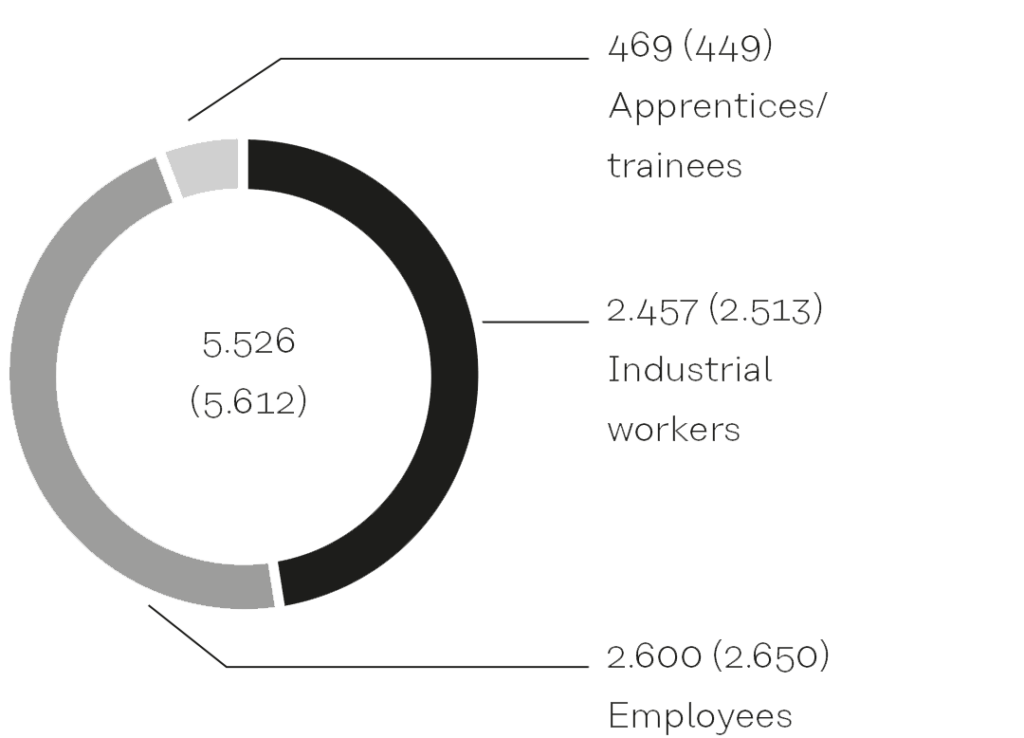
Koenig & Bauer’s global footprint is reflected in the Group export ratio of 89.0% (previous year: 87.1%). Eleven production sites in Europe result in a high level of vertical integration in production, ensuring reliable supplies and production. The range of services includes the precision machining of large parts made of cast iron or steel, the manufacture of complex components, and engineering and assembly services. Numerous sales and service organisations also contribute to the global footprint. As of 31 December 2025, the Group employed 5,526 people worldwide (previous year: 5,612; 2023: 5,741).
Since the launch of the “Spotlight” focus programme at the end of 2023, the number of employees has decreased by a total of 215. The total capacity adjustment of around 300 full-time equivalents (FTE) sought in the programme was achieved through a combination of personnel and structural measures. In addition to voluntary termination benefits, the reduction of the weekly working time from 40 to 35 hours in the addressed areas contributed significantly to achieving the capacity target while stabilising the core workforce. In addition measures included flexible working time instruments, voluntary salary waivers, and a targeted reduction in outstanding vacation entitlement. Due to their design and timing of implementation, these measures are gradually impacting the personnel cost structure. Due to capacity utilization factors, short-time working was used to a minor extent at three sites (previous year: five).
As part of the Group’s ongoing strategic refocusing – and following the review of Koenig & Bauer Coding GmbH carried out in July 2025 – the decision taken in January 2026 to cease operations at Albert-Frankenthal GmbH with effect from 31 May 2026 represents the logical next step. For the 75 employees affected, the aim is to find a socially responsible solution within the framework of a redundancy plan, as well as to provide active support in finding new employment.
Workforce as of 31. Dezember 2025
Koenig & Bauer promotes a culture of innovation and has been closely involved in vocational training since its foundation over 200 years ago in order to maintain its technological lead and to address the shortage of skilled workers and the effects of demographic change. With numerous training opportunities at the Koenig & Bauer Academy and the Koenig & Bauer Campus learning management system, the company is continuously developing its employees and also ensuring requirements-oriented succession planning. To secure competitiveness, the “AI Empower 25” programme was implemented in the reporting year. The aim is to qualify employees in the application of artificial intelligence (AI) to create the technological basis for future efficiency increases. The programme follows a decentralised training approach where multipliers support the integration of technology into the specialist departments. In the first year of its term, the use of AI tools in the organisation has already increased significantly. Exemplary approaches were awarded for the first time in December 2025 with an internal “AI Innovation Award”.
The training of junior staff remains a strategic pillar for meeting the demand for skilled workers. As of 31 December 2025, there were a total of 469 (previous year: 449) apprentices and interns in the company. Koenig & Bauer adheres to its strategy of making permanent job offers to qualified apprentices after successful completion. In 2025, 103 (previous year: 159) apprentices and dual-course students started their careers at the German and Austrian sites. As the company has reached its maximum training capacity, the number of new admissions was stabilised while simultaneously specialising the training courses to ensure high-quality training across all year groups. Consequently, all advertised positions were again filled, and the portfolio was expanded to include new job profiles, such as in production metrology, to meet Koenig & Bauer’s future requirements. The largest career groups are mechatronics technicians, industrial mechanics, and IT specialists. Here, the company’s own vocational school at the headquarters ensures qualification precisely tailored to the company’s technologies.
Sustainability
Sustainability is an integral part of Koenig & Bauer’s strategic guidelines. The company aligns its actions to combine technological progress with ecological and social responsibility. In a market environment characterised by increasing regulatory requirements and a growing awareness of resource conservation, Koenig & Bauer supports its customers in the transformation towards sustainable production processes. The packaging industry faces the challenge of reconciling ecological requirements, such as the EU Packaging and Packaging Waste Regulation (PPWR), with economic efficiency. Through innovations in printing and finishing technology, the company contributes to increasing the recyclability of packaging and optimising material usage.
Decentralised organisation with a holding company structure
Group structure
The Koenig & Bauer Group is composed of Koenig & Bauer AG as the holding company and its subsidiaries. As of 31 December 2025, 41 companies (previous year: 37) were included in the consolidated financial statements in addition to Koenig & Bauer AG. Two companies are accounted for using the at-equity method (previous year: two companies).
In the 2025 financial year, the realignment of the Group organisation and segment structure was completed. The Group is now managed via two segments instead of the previous three: Paper & Packaging Sheetfed Systems (P&P) and Special & New Technologies (S&T). This structure is aligned even more closely to current and future customer needs as well as the applicable business model, enabling a streamlined organisation.
Koenig & Bauer AG, as the holding company, has streamlined its tasks as part of this realignment and assigning more operational responsibilities to the two segments. In addition to pursuing the Group`s strategic responsibilities, the focus of the holding company continues to be in the areas of shared services for all Group subsidiaries, such as IT, human resources, investor relations, communications, central purchasing, and financial services. In the course of the reorganisation, the Executive Board was also reduced to a dual leadership, consisting of the CEO and CFO in the reporting year.
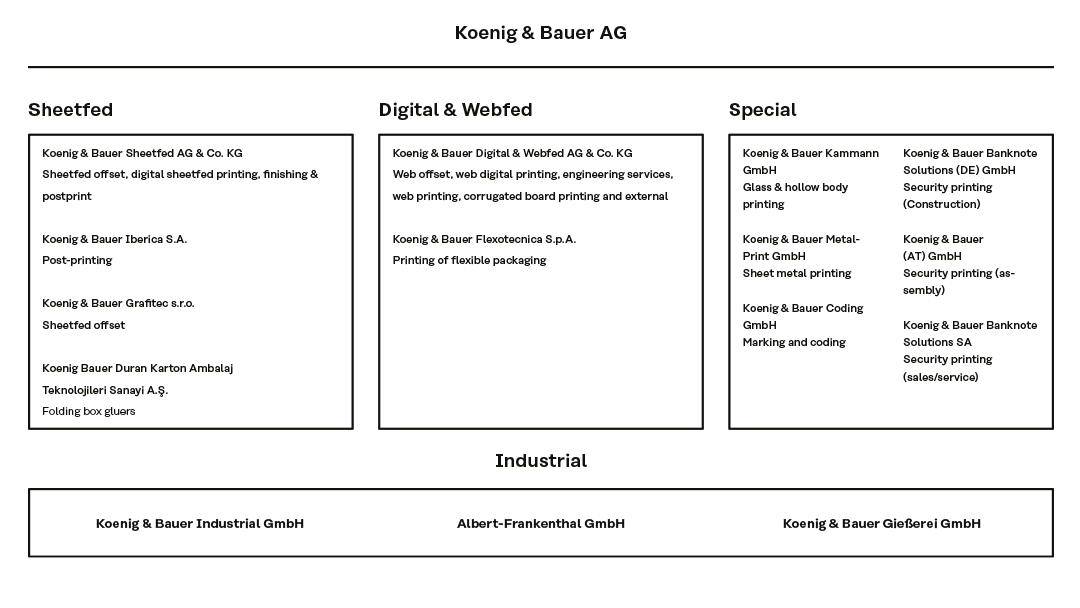
As shown in simplified form in the diagram setting out the 2025 Group structure, the production subsidiaries are allocated to the two segments P&P and S&T on the basis of their business activities. The domestic and foreign companies, which offer sales and service functions for several segments are allocated to the segments in accordance with their activities. Similarly, the business units defined as production service providers (“Industrial”) are allocated to the two segments on the basis of their activities. Industrial acts as a production service provider within the Group, manufacturing high-precision components for printing presses in conjunction with other companies. It specialises in precision-machined large parts made of cast iron or steel, complex prismatic rotating parts, gears, curves, sheet metal assemblies, rollers, and the environmentally friendly coating of rotating parts. In addition, Industrial offers further services such as assembly, engineering, and logistics.
Business activities of the segments
In line with its operating business, the internal reporting structure of the Koenig & Bauer Group is divided into two segments since 1 January 2025: Paper & Packaging Sheetfed Systems (P&P) and Special & New Technologies (S&T). These also form the reportable segments in accordance with IFRS. Segment revenue is split into printing presses, services including spare parts (service), and other. Services include both digital and classic services.
The Paper & Packaging Sheetfed Systems (P&P) segment consolidates all business activities of the former Sheetfed segment. Due to technological and customer overlaps between folding box and corrugated cardboard producers, the bundled corrugated cardboard activities for the Chroma series (Celmacch joint venture) were also transferred from the former Digital & Webfed segment to this segment.
Under the “Chroma” brand, the segment offers a comprehensive portfolio of corrugated cardboard direct printing systems for all price and performance classes. The product range bundles the “Chroma” series sold through the Koenig & Bauer Celmacch joint venture and the proprietary high-board corrugated cardboard system. Additionally, a digital post-print solution for corrugated cardboard printing is offered via the Koenig & Bauer Durst joint venture.
Under the “Rapida” brand, the segment offers a comprehensive portfolio of sheetfed offset presses from half to super-large format for packaging and commercial printing. Complementing classic sheetfed offset technology, the VariJET 106 (Koenig & Bauer Durst joint venture) offers a digital printing solution that can also be equipped with sheetfed offset units and finishing options for hybrid production.
In addition to offers for commercial printing, the strategic focus in the P&P segment lies on holistic system solutions for the growth markets of folding boxes and corrugated cardboard boxes. Within a continuous 360-degree packaging workflow, all production steps are covered – from prepress and analogue, digital, or hybrid printing and finishing of the sheets to industrial post-processing through flatbed or rotary die-cutters and folding box gluers. This offer is supplemented by a comprehensive service and support area with the focuses “Technology – Service Select” and “Productivity – Service Complete”. The latter includes, for example, the realisation of seamless digital workflows and the use of digital products such as myKyana for process optimisation and VisuEnergy X for sustainable energy management.
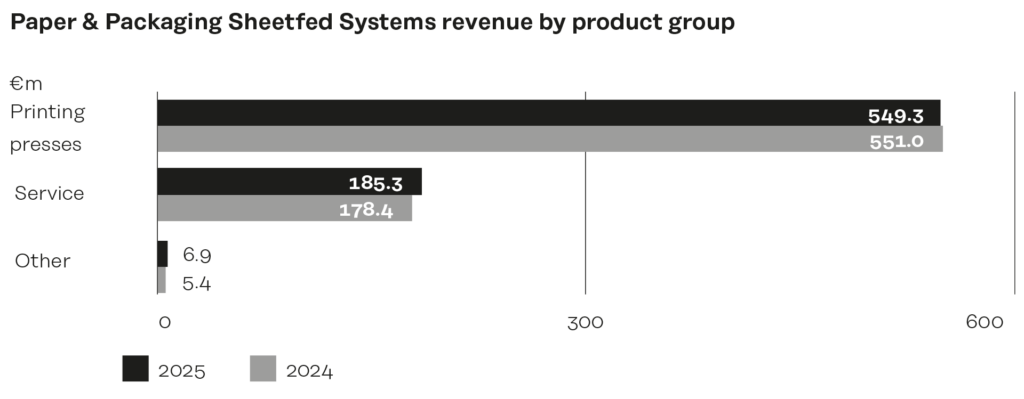
The following chart shows the revenue generated in press and service business in the P&P segment. The share of service business widened slightly to 25.0% (previous year: 24.3%) compared with the previous year, while the share of press business remained stable. Efforts are continuing to achieve the Group target of around 30%.
In the Special & New Technologies (S&T) segment, Koenig & Bauer bundles the activities of the former Special segment (special presses for banknote and security printing, systems for industrial marking and coding, and special systems for metal and glass/hollow container direct printing) as well as the remaining business areas from Digital & Webfed (web-based printing processes such as the “RotaJET” web digital printing presses, systems in cooperation with HP for the pre-print of corrugated board liners and letterpress printing, CI flexo printing presses, and web offset presses). The segment also serves to open up new application areas and bundles future-oriented innovation topics. It includes the independent business units Vision & Protection GmbH (inspection systems and product safety) and Kyana GmbH (digital ecosystem and digital experience), as well as the joint venture with PowerCo SE in the field of dry coating for battery cell production. Thus, the segment addresses highly specialised printing processes for global niche markets and future-oriented technology fields.
Banknote Solutions develops and builds highly complex printing systems for banknote and security printing. The range of services covers the entire workflow from banknote graphics and specialised design software to the prepress stage and production on offset, intaglio, and screen printing presses. The portfolio also includes expertise in banknote and security design as well as the development of security elements. These products and services are used by central banks and private printers to producte banknotes. A significant focus is on the modular architecture of the platforms: customers can combine individual modules individually and remain flexible for future requirements through subsequent expansion options.
Kammann supplies printing systems for direct decoration of glass and plastic hollow containers. The following decoration methods are used: digital printing, screen printing, hot stamping, and labelling. Hybrid solutions permit these processes to be combined in a single press, thus offering a high degree of flexibility in the design of the printed image and enabling special effects and unique designs for individual packaging solutions. Directly decorated glass containers are mainly used for cosmetics, perfume and spirits products in the premium segment.
MetalPrint provides comprehensive system solutions for the decoration of metal sheets in the metal packaging industry. The portfolio includes offset and digital metal printing presses, coating machines, and drying systems with integrated exhaust air purification. For the finishing of cans, closures, and metal containers – such as for food, cosmetics, or technical applications – precisely configured production lines are used that print, coat, and dry metal sheets with high efficiency in an integrated process. With the digital MetJET series, MetalPrint is expanding the possibilities for individualisation and increasing flexibility in production.
Coding offers labelling solutions for a wide range of industries, from pharmaceuticals and cosmetics to food and technical applications. Variable data, logos, and barcodes are printed, marked, and coded on different substrates on a just-in-time basis. Production reliability and speed in conjunction with an excellent typeface are of crucial importance in order, for example, to apply the best-before date or batch traceability accurately. Manipulation-proof labelling and seamless product traceability are becoming increasingly important.
Web-based printing systems: The segment also includes a broad portfolio for the high-pressure (flexo), planographic (web offset), and digital printing processes. The offer ranges from classic web offset presses for newspaper, commercial, and publication printing to digital web presses such as the RotaJET platform. In cooperation with HP, the HP PageWide T1190 and T700 printing systems are offered for the pre-print of corrugated board liners, as well as the HP PageWide T500 for digital book printing. The product portfolio also includes CI flexo printing presses in various performance classes, which enable a modular design with up to ten printing units and optional inline finishing units. These are suitable for printing on plastic films, paper, and laminates and are primarily used in the production of flexible packaging, especially for the food industry. Various automation modules are offered, tailored to the individual needs of the web presses – for example, integrated paper logistics and customised workflow solutions.
In addition to the machine portfolio, the segment offers comprehensive services ranging from upgrades & retrofits to remote monitoring using digital tools, customised training and individual service contracts.
Vision & Protection GmbH: The unit bundles competencies for high-performance inspection systems for quality control and innovative solutions for product safety. Under the “Protected at Print” approach, authentication solutions such as Ovjera, Stegano, and Daktylo are offered, which securely link physical products with the digital world.
Kyana GmbH: The company acts as the central point of contact for the digital product world of Koenig & Bauer. The digital ecosystem includes the AI-supported platform myKyana, Kyana Assist, Kyana Data & Connect, and the central data hub LogoTronic. The unit addresses the Digital Experience area with the AURAVEO platform, which enables direct interaction between brand owners and consumers through “Connected Packaging”.
Strategic partnership with PowerCo SE: Within the framework of a strategic development cooperation with the Volkswagen subsidiary PowerCo SE, Koenig & Bauer’s technological know-how is utilised to industrially scale innovative processes for the dry coating of electrodes for battery cell production, thereby significantly reducing energy consumption in production.
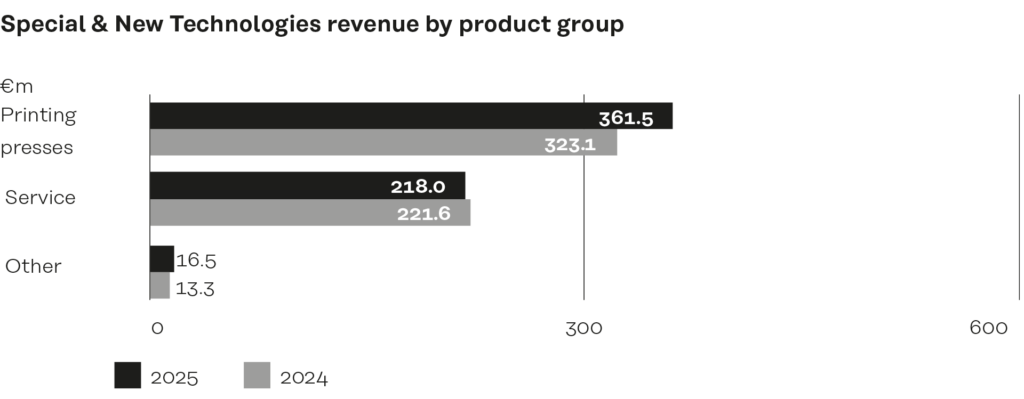
The following chart shows the revenue generated in press and service business in the S&T segment. While press revenue was increased significantly in 2025, revenue in the service business declined slightly compared with the previous year. Accordingly, the share of service business in total segment revenue decreased to 36.6% from 39.7% in the previous year.
Management and governance
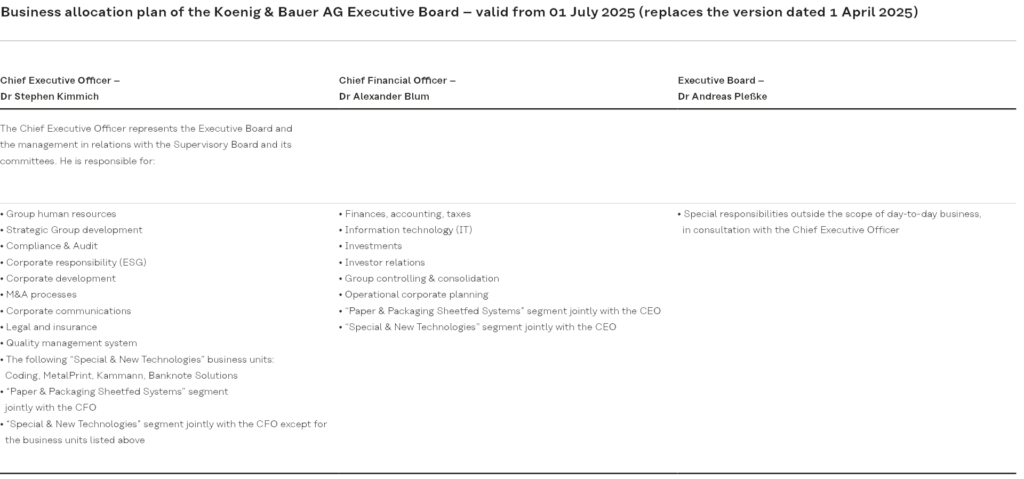
Koenig & Bauer AG is a public limited company (“Aktiengesellschaft”) under German law with a dual management structure. Its Executive Board consisted of three members as of 31 December 2025:
• Dr Stephen Kimmich (Chief Executive Officer; appointed until 30 June 2030)
• Dr Alexander Blum (Chief Financial Officer; appointed until 31 July 2028)
• Dr Andreas Pleßke (Member of the Executive Board until 31 December 2025)
The 2025 financial year marks the completion of the generational change on the Executive Board. With a resolution dated 27 May 2025, the Supervisory Board defined the target structure of the Executive Board. Dr Stephen Kimmich succeeded Dr Andreas Pleßke following the Annual General Meeting on 4 June 2025; Dr Pleßke actively supported the transition until his scheduled departure at the end of the year by assuming special responsibilities. With the appointment of Dr Alexander Blum on 1 July 2025, the CFO responsibilities were newly filled.
The business allocation plan shown illustrates the assignment to the Executive Board areas and segments as well as the distribution of functional responsibilities within the Executive Board until 31 December 2025. With the scheduled departure of Dr Andreas Pleßke at the end of the year, this business allocation plan will continue to apply unchanged from 1 January 2026 in the target structure of the Executive Board dual leadership.
The business allocation plan (see p. 24) which came into effect on 1 January 2026 finally reflects the new structure.
Goals and strategy
Strategic framework “IMPACT”
Since 2021, the “Exceeding Print” strategy guided the Group. In December 2025, Koenig & Bauer adopted the new strategic framework “IMPACT” to realign priorities against the backdrop of changed global conditions and established the medium-term strategic direction. “IMPACT” is based on sound market analyses and defines a common direction to actively shape the future of the printing industry and secure operational resilience for the next decade.
Market environment and strategic challenges
Koenig & Bauer operates today in a market environment shaped by increasing volatility and geopolitical complexity. Trade restrictions and protectionist tendencies require a high level of flexibility from the global organisation. In parallel, European mechanical and plant engineering faces structural challenges: rising cost structures and complex regulatory requirements challenge international competitiveness. At the same time, the technological catch-up process of international competitors is leading to an intensification of price competition, particularly in cost-sensitive market segments. Added to this is a persistent shortage of skilled workers which is slowing growth, while the full potential of digitisation and Industry 4.0 has still not been exhausted and global supply chains remain vulnerable due to protectionism..
To counter these developments proactively, Koenig & Bauer consistently aligns its strategic framework with the four central trends of the printing industry:
Regional shifts and mid-tech market: Global demand in packaging printing is increasingly shifting towards emerging markets. By 2033, Asia is expected to account for over 46% of global market volume. India, Latin America and the Middle East, in particular, are driving this global trend. These new markets increasingly demand solid “mid-tech” products where cost-effectiveness, productivity, and reliability are decisive.
Intelligence & automation: Automation of production processes has evolved from an option to a necessity to achieve efficiency increases and counteract the global shortage of skilled workers.
Digital printing: Industrial inkjet printing is recording dynamic growth (expected CAGR of 7% until 2034) and is expected to take up a substantial share of the total value of the printing market by the mid-2030s.
Resilience: Flexibility in supply chains, versatility with substrates, decentralised production, and nearshoring are becoming decisive competitive factors.
An integral system for increasing competitiveness
These market realities illustrate that isolated individual measures are no longer sufficient. The “IMPACT” strategic framework is therefore designed as an integral system in which all aspects are mutually dependent: a successful go-to-market strategy requires the technological solutions that the market demands, while at the same time the operational flexibility must exist to react at lightning speed to new conditions. The heart of this structure is the Group’s workforce, which ensures consistent transformation through commitment and speed. Actions are bundled in six central pillars
I – Intelligence: AI and automation as value drivers
The “Intelligence” pillar forms the Group’s digital backbone. Koenig & Bauer is consistently establishing artificial intelligence (AI) in all business areas – from the administrative workplace to machine control. With the “AI Empower” project, the Group provides modern software tools to minimise routine tasks and create space for complex problem-solving. Externally, digital intelligence is merging with physical automation, with software increasingly acting as the “soul” of the system. Through solutions such as the AURAVEO platform and AI-supported quality systems in the Vision & Protection area, interactive communication channels and innovative authentication solutions are created that go beyond traditional print features and enable data monetisation.
M – Market: Focus on scaling and global market penetration
Under the “Market” pillar, Koenig & Bauer focuses on a sharpened go-to-market approach for scaling the existing, broad product portfolio (including VariJET, Chroma, CI flexo, and RotaJET). In view of regional shifts, the Group is concentrating increasingly on growth markets in India, LATAM, and the Middle East. For this purpose, demand-oriented product variants are developed that are optimally suited for these regions in terms of price, performance, and service. A central goal is to close gaps in the high-volume mid-tech segment.
P – People: Competence, performance, and pace
The “People” pillar defines the workforce as the foundation of transformation. Koenig & Bauer is investing heavily in upskilling and talent management to master the technologies of tomorrow with confidence. In a volatile environment, speed (“pace”) becomes a critical success factor. Operational responsiveness is increased through streamlined organisational structures and accelerated decision-making processes. The goal is a performance culture in which people “work smarter”. AI supports the acceleration of administrative processes and eliminates routine. Thus, pace is not understood as pure speed, but as an acceleration of the operational rhythm to secure competitive advantages over agile market participants with significantly shorter cycles.
A – Adaptability: Resilience through flexibility and global footprint
Adaptability is the answer to the volatility of the global economy. Koenig & Bauer strengthens its resilience by optimising the global footprint and supply chains to reduce dependencies. The goal is a model that constantly utilises internal capacities and flexibly cushions demand peaks via internal and external resources. A major financial anchor is the planned absolute increase in revenue from service business in order to secure a service revenue share of permanently at least 30% within the scope of our IMPACT growth targets. Through more intensive support of the installed base and new digital service products, the Group becomes more independent of cyclical new machine business. Resilience here means not just crisis management, but the ability to grow actively even under demanding conditions..
C – Competitiveness: Economic superiority in competition
Technological high-tech leadership must be financially secured through success in the mid-tech area. Koenig & Bauer counters price pressure with demanding initiatives to optimise manufacturing costs and is moving from pure cost savings towards intelligent value optimisation (design-to-cost). Competitiveness against providers with advantageous cost structures is strengthened through more efficient design and leaner structures in assembly and management. This also includes establishing local partnerships and tailor-made products for price-sensitive markets. The goal is to lead technologically and win economically at the same time to guarantee the financial freedom of action for future innovations.
T – Technology: Software ecosystems and digital printing pioneer role
The central value proposition is shifting increasingly from hardware to networked software ecosystems. Koenig & Bauer relies on open interfaces (connectivity) to third-party providers as a central differentiating feature. In industrial digital printing, the Group is consistently expanding its market shares through customer-oriented solutions. In view of the expected market growth of inkjet technology, continuing the path as a pioneer remains a central strategic pillar. Technology is understood here as an enabler to make customers successful. The promise for 2030+ is to remain an innovation driver for hardware, software, and new process solutions and to merge hardware consistently with digital intelligence.
Attitude “I ACT” and strategic objectives
The IMPACT strategy unfolds its full impact through personal attitude: under the motto “I ACT”, every individual assumes responsibility for translating strategy into measurable success for customers and shareholders. Implementation is driven forward through the consistent optimisation of Group structures. In continuation of the strategic Group focus – and following the review of Koenig & Bauer Coding GmbH in July 2025 – the decision made in January 2026 to cease operations at Albert-Frankenthal GmbH by 31 May 2026 constitutes the consistent next step.
Strategic integration with IMPACT: The impulses gained within the scope of the “Spotlight” focus programme and the structural sharpening achieved support the successful implementation of the new strategic framework IMPACT. While “Spotlight” has contributed specifically to strengthening the operational base in the short and medium term, IMPACT now extends this focus to long-term resilience and technological positioning up to 2030+. The concentration on operational excellence and cost efficiency initiated by “Spotlight” finds its consistent continuation in the IMPACT pillar Competitiveness.
Markets addressed and growth opportunities
With its range of product and service, Koenig & Bauer addresses the sub-markets of packaging, industrial, security, banknote, commercial and publication printing, and furthermore targets potential in adjacent markets and in the area of digital business models. Within the strategic framework “IMPACT” adopted in December 2025 – with its six pillars Intelligence, Go-to-Market, People, Adaptability, Competitiveness, and Technology – the company aligns its priorities to strengthen the resilience of the Group and consistently exploit market opportunities through technological innovation. Each of these markets has specific dynamics, which are explained below.
Future opportunities in packaging printing
The Koenig & Bauer Group’s focus is on the structurally and sustainably growing market for packaging. The company offers solutions for all major substrates such as cardboard (corrugated board, folding boxes, liquid packaging), flexible packaging, hollow bodies made of plastic, as well as metal and glass. Market growth is primarily driven by the growing world population and rising number of middle-class households with purchasing power, correlating with global gross domestic product (GDP).
This trend is reinforced by a shift in global purchasing power: by 2030, it is expected that around two-thirds of the global middle class will be based in Asia. In China and India in particular, growth of approx. 1 billion people each is projected in this segment. To participate in this volume growth, Koenig & Bauer increasingly addresses the mid-tech markets with specifically configured solutions that combine high productivity with cost efficiency.
In addition to rising global consumption, e-commerce (e-commerce and quick commerce) as well as smaller packaging units due to the increase in single-person households are boosting demand. Additional momentum results from regulatory requirements such as the EU Packaging and Packaging Waste Regulation (PPWR) and the introduction of the Digital Product Passport (DPP). In parallel, the “GS1 Sunrise 2027” initiative requires the transition to two-dimensional data carriers (QR codes) on every packaging unit. As these codes require highly dynamic, individual data, demand for variable high-performance printing systems and software solutions is increasing.
On average, global packaging printing is growing by around 4% annually, with Koenig & Bauer holding a strong position particularly in the less cyclical areas of food, beverages, and pharmaceuticals. Packaging is increasingly acting as a brand ambassador. The “unboxing” experience in the private environment reinforces this trend and stimulates demand for high-quality finished surfaces, multicolour-printed interiors for corrugated boxes, and personalised inserts.
Growth opportunities through digital printing and in industrial printing
Analogue technologies such as flexo, gravure, offset, and screen printing currently still dominate the global packaging printing sector. According to a recent study by Smithers, the proportion of digital printing account for around 4% (by volume) of the total global print production volume, while the share by value is already around 18%. By 2034, this share by value is expected to rise to around 25% (around 7% by volume), with the largest changes expected in the packaging sector. Although digital printing is relatively expensive compared to analogue processes, it offers decisive advantages: it enables individualised, personalised, and versioned prints in small print runs. This reduces the required capital expenditure (CapEx) for customers by eliminating expensive stockholding. Furthermore, ease of operation by trained personnel in times of skilled worker shortages represents a clear advantage, supplemented by the elimination of makeready times and minimised waste.
Digital processes such as inkjet printing are successful where they offer technically and economically convincing solutions for business models with a focus on short runs, high format flexibility, and fast time-to-market production. Koenig & Bauer addresses this trend with a comprehensive portfolio ranging from the VariJET 106 for folding box printing to the RotaJET family for high-volume digital printing, through to the CorruJET for direct printing on corrugated board and specialised solutions such as the MetJET ONE and the Kammann K4. Following the latest orders, the company sees great potential for replacing traditional gravure and flexo presses with digital high-performance machines. This simplifies design handling and significantly shortens the time to print. In decor printing for furniture and flooring, the technology enables fast design changes and cost-effective testing of new ideas. In the corrugated board sector, products communicate directly at the point of sale (POS) through digital pre-print or direct print with water-based, food-certified inks, whereby the packaging increasingly takes on the function of a marketing and sales tool. Shorter marketing cycles are also leading to changed production requirements for liquid packaging and film packaging. The main driver for the switch to digital production remains the consistent improvement of the total cost of ownership.
Digital products: AURAVEO – “Connected Packaging”
Beyond the classic machine business, Koenig & Bauer is opening up digital revenue potential through the newly founded Kyana GmbH with the AURAVEO platform. The technological linking of physical packaging with digital content (“Connected Packaging”) transforms the packaging into an interactive communication channel between brand and consumer. Thus, for the first time, the company directly addresses the marketing budgets of brand producers, who use these solutions for direct-to-consumer strategies and customer engagement. This forms the basis for scalable, data-based business models beyond the physical printed product.
Security and authentication solutions: “protected at print”
Under the strategic umbrella “protected at print”, Vision & Protection GmbH transfers expertise from high-security printing to brand protection for consumer and industrial goods. In view of rising product piracy worldwide, Koenig & Bauer specifically targets the security and anti-counterfeiting budgets of brand owners here. With cryptographic features (e.g. aegis, Daktylo, Stegano) and the verification app “ava”, the company offers a closed system for authentication directly in the standard printing process. Intelligence in the machine thus becomes the decisive purchasing criterion for seamless product protection.
Global demand for banknotes creates stability in security printing
Thanks to its good project situation, very low cyclical exposure and very high barriers to market entry, Koenig & Bauer expects business in security printing presses to remain stable in the long term. Cash remains an indispensable and secure means of payment, especially in the second and third world. In view of the highly intense competition, the newly developed, innovative security features are a decisive differentiator and a unique selling point. Despite the increased use of digital payment methods, global banknote production continues to grow at a moderate rate. Growing prosperity and rising population numbers in emerging markets with their high cash ratios as well as widespread scepticism towards electronic payments mean that there will be no reversal in this trend in the market in the medium term, although developments in some countries will vary. Alongside intensive work on new products and security features, service business for the large installed base is being systematically expanded and will make a good contribution to Group earnings in the medium to long term. With packaging printing contributing a larger share of Group revenue, the influence of volatile security printing business will recede.
Stable conditions in media-related printing segments
Koenig & Bauer anticipates stable growth in the market for sheetfed offset presses for commercial printing, supported by a globally stable to slightly growing book market. Industrial digital printing is continuing to gain importance in the publishing industry in order to meet the trend towards shorter runs and demand-oriented production (print-on-demand). In web offset presses for newspaper and commercial printing, a declining new machine business and a downward trend in service business are expected due to further press shutdowns and print shop closures.
Expansion of service with a focus on digitisation
The Koenig & Bauer Group positions itself as a provider of holistic system solutions beyond the mere manufacture of printing and finishing machines. The goal is to strengthen the competitiveness of customers on a sustainable basis through a comprehensive service portfolio. This range includes classic services such as inspection, maintenance, and calibration, as well as retrofits and upgrades to extend the plant lifecycle. Spare parts, consumables, and accessories can be efficiently sourced via integrated webshops. Since qualified specialist personnel and the optimisation of the print shop workflow are decisive for productivity alongside innovative technology, targeted training and consulting services supplement the spectrum. In a market environment shaped by increasingly short runs, shorter delivery times, and high cost pressure, Koenig & Bauer differentiates itself as a globally present and long-established partner combining flexibility with technological excellence.
As a result of the increasing digital networking of work processes, Koenig & Bauer is systematically developing its service business – which contributes around 30% to Group revenue – into a digital ecosystem under the myKyana brand. In this process, classic, physical service activities are increasingly supplemented and networked with data-based digital offerings. In this way, the company is responding to the market trend for a data-supported increase in overall equipment effectiveness (OEE). The technological basis for this is a secured cloud connection for the machines (Kyana Connect), which enables continuous monitoring and optimisation of production processes using real-time data analysis (Kyana Data). To meet the structural challenges of the global skilled worker shortage and the rising demand for maximum plant availability, the company is increasingly relying on AI-supported assistance systems (Kyana Assist) as well as visual remote support. These solutions aim to make expert knowledge available immediately at the machine, increase the first-time-fix rate, and minimise the risk of unplanned downtimes through predictive maintenance. Additionally, Koenig & Bauer addresses the growing market and regulatory requirements for resource efficiency. Through integrated energy management systems (VisuEnergy X), data-supported optimisation of energy consumption is enabled, whereby the company supports the customer’s need for economically efficient and sustainable production. Thus, the company positions itself in a market environment increasingly shaped by the merging of industrial production and digital intelligence.
Markets outside the printing industry
Koenig & Bauer has also discovered new markets for itself outside the classic markets of the printing industry. Examples include the partnerships with Volkswagen subsidiary PowerCo SE and with Mitsubishi Electric in response to the expected increase in demand for lithium-ion batteries due to the growing popularity of electric vehicles. According to calculations by the Boston Consulting Group, the supply of lithium-ion batteries will need to increase tenfold by 2030 to meet market demand.
Partnerships and cooperations
Koenig & Bauer specifically uses partnerships and cooperations to promote innovation and growth, including outside the established markets. By working together, synergies can be harnessed and the defined goals achieved more quickly and more efficiently. The examples listed here – in the areas of machinery, consumables, digitalisation, product protection, new business, and sustainability – provide an insight into the diversity of Koenig & Bauer’s partnerships and cooperations. This list is not exhaustive.
In the area of digital printing: A partnership has existed with HP since 2014 for the manufacture of the HP PageWide T1190 and T700 printing systems for the pre-print of corrugated board liners, as well as the HP PageWide T500 for monochrome book printing. Established in 2019, the joint venture with the Durst Group develops and markets digital printing systems; these include the CorruJET and the DELTA SPC 130 for digital direct printing on corrugated board, and the VariJET 106 for digital folding box printing. Since 2024, the joint venture has also offered a digital printing solution for metal decoration with the MetJET ONE (multi-pass).
In the area of corrugated board: Since 2022, Koenig & Bauer Celmacch has addressed a comprehensive product portfolio in all price and performance classes for the corrugated board market with the Chroma product family.
Im Bereich der Consumables: Koenig & Bauer relies on long-term partnerships to optimise printing processes. The cooperation with ACTEGA (finishing technologies) was extended by three years in 2024, while System Brunner has been contributing its core competence in colour management to Koenig & Bauer’s sheetfed offset technology for over ten years.
In the area of digitalisation: To drive forward the digital transformation, Koenig & Bauer relies on a strong partner network. The collaboration with Google Cloud (since 2023) enables the efficient management and processing of enormous amounts of data. In April 2025, a strategic partnership was formed with Siemens to capture more detailed machine data using new technologies and to improve digital solutions for condition monitoring and process optimisation. In cooperation with osapiens, the subsidiary Kyana GmbH is developing solutions for the implementation of the Digital Product Passport (DPP). In this context, the Digital Experience Platform AURAVEO is connected with the osapiens HUB to link regulatory requirements for supply chain transparency with interactive brand communication. The cooperation with HYBRID Software, a provider of software solutions for the labels and packaging market, also enables Koenig & Bauer to offer PrintFusion, an exclusive product for the packaging workflow on Rapida sheetfed offset presses, thereby optimising the entire production process. In addition, the company cooperates with the University of Applied Sciences Würzburg-Schweinfurt and the Steinbeis Research Centre Design & Systems.
In the area of product protection: Koenig & Bauer Vision & Protection GmbH bundles its activities under the strategic initiative “protected at print”. The goal of this initiative is to support print shops in extending their value chain and positioning themselves as full-service protection partners for their customers. A central component is the cooperation with Bosch Secure Authentication GmbH, started in October 2025, to realise brand protection and traceability directly in the printing process through the integration of digital security features (“Ovjera”).
Opening up new business areas: Koenig & Bauer opens up new business areas through strategic partnerships that go beyond the traditional printing business. The partnership with PowerCo SE (Volkswagen) to develop a system for the solvent-free dry coating of electrodes reached a decisive milestone in June 2025 with the successful proof of concept. To prepare for industrial series production, the plant was subsequently moved to a pilot line at PowerCo; the scaling phase is scheduled for completion in 2026. In the field of industrial image processing, the partnership with Mitsubishi Electric (since 2024) bundles the strengths of both companies for electrode production (inspection module Qi<+>PRO).
In the area of sustainability: Koenig & Bauer is a partner of the VDMA Blue Competence initiative as well as a member of Healthy Printing, 4evergreen, Holy Grail 2.0, and the R-Cycle community. Social engagement was expanded in 2025 through the global “MoneyBox” initiative in cooperation with Aflatoun International, which teaches children financial literacy. Additionally, Koenig & Bauer is driving the development of an integrated ecosystem for financial education together with the fintech Doshi.
Planning, control and monitoring
Comprehensive set of tools for efficient Group planning and control
The established business management system with differentiated cost accounting provides management with a swift and meaningful set of figures for operational controlling, monitoring and strategic planning and management of the Group and the segments. In addition to central Group controlling for the overarching Group and segment management, the autonomously operating business units have access to controlling resources. The results of the annual strategy process culminate in high-level business planning and are presented in detail in the ensuing integrated budget planning phase. The planning horizon for high-level business planning and budget planning is five years. The budgets for the Group and the segments are based on detailed income statements, balance sheets and cash flow statements for all consolidated Group companies, which are prepared on a monthly basis in the first budget year. Forecasts for the current year are updated on the basis of the reported figures at the same time as the semi-annual and quarterly (Q1 and Q3) financial statements are prepared and also shortly before the end of the year. Scenario analyses simulate different market and cost parameters on a case-by-case basis. Monthly reporting tracks the current business and earnings situation as well as trends in net working capital and is discussed in the monthly earnings meetings. Service reporting permits coordination of the service activities. Roll-over liquidity previews with cash management provide an accurate view of the financial situation. A 24-month liquidity budget is prepared for this purpose. Regular reviews by Group management with the responsible segment managers addressing the economic and financial situation, current trends and forecasts supplement deviation analyses performed by controlling. Measures are defined in the event of any negative deviation in the interests of a swift and targeted response. Systematic implementation of the measures is tracked by close monitoring. Opportunities and risks are detected at an early stage by means of an established budget, forecast and reporting process. A risk early detection system has been established to monitor developments and to identify possible threats to the company’s going-concern status. The necessary decisions can be made at an early stage on the basis of this comprehensive assessment of Group and segment performance.
In the Koenig & Bauer Group, revenue and operating EBIT (earnings before interest and taxes) are the most significant financial performance indicators across all segments for the 2025 financial year. Operating EBIT is defined as earnings before income taxes, interest income and expenses and other financial result, adjusted for non-operating items. EBIT is adjusted for the following items:
- Expenses/income from Group portfolio measures (acquisitions, disposals, adjustments and other portfolio-related measures, including changes in goodwill)
- Expenses/income in connection with restructuring projects
- Expenses/income from consolidation changes during the year
- Expenses/income due to the first-time application of Group guidelines with regard to personnel adjustments – expenses for pension plans
With the beginning of the 2026 financial year, the legal representatives of Koenig & Bauer AG have decided to shift the guidance to operating EBITDA. From now on, this key figure will function alongside revenue as the most significant financial performance indicator and will replace operating EBIT. In this way, the company is taking account of the sought-after sharpening of the focus on operating cash generation, improved comparability within the peer group and the future requirements of IFRS 18.
The operating EBIT margin also counts as a financial performance indicator. It is defined as operating EBIT divided by revenue. Since the 2024 financial year, Koenig & Bauer has used the operating EBIT margin instead of the EBIT margin as a financial performance indicator. With the change in guidance on 1 January 2026, Koenig & Bauer will use the operating EBITDA margin instead of the operating EBIT margin as a financial performance indicator from the 2026 financial year onwards. The operating EBITDA margin is defined as operating EBITDA divided by revenue.
In addition to these main financial performance indicators, the Executive Board receives reports on order intake, order backlog and service business indicators. Changes in capital employed are monitored on the basis of the cash conversion cycle. The ratio of inventories, prepayments made for inventories and trade receivables less trade payables and customer prepayments to revenue is calculated to determine this indicator. In addition to financial indicators, the Executive Board also tracks non-financial performance indicators, particularly quality assurance costs and staff development. Target agreements providing for variable remuneration components tied to Group, segment and/or personal goals for the year for all executives and non-pay-scale employees heighten motivation and commitment towards the achievement of the company’s goals.
Research and development
In its research and development activities in the 2025 reporting year, Koenig & Bauer focused primarily on the fields of digitalisation, workflow optimisation, product protection and sustainability. The aim of the innovation activities is to increase overall equipment effectiveness (OEE), safeguard product integrity and reduce resource consumption over the entire life cycle of the machines. In the 2025 financial year, research and development expenses in the Group amounted to 3.5% of revenue (previous year: 4.3%). In addition, development costs amounting to 0.7% of revenue were capitalised (previous year: 1.1%).
Digitalisation and workflow solutions: With the founding of Kyana GmbH as of 1 April 2025, the development of digital business models was made organisationally independent. Under this new organisational roof, the focus was on the functional expansion of the myKyana digital ecosystem introduced in the previous year. One step forward was the integration of post-press systems (further processing) as well as units from third-party providers. This enabled the realisation of a cross-manufacturer connection along the entire value chain, providing customers with seamless data transparency for identifying process bottlenecks in real time. In addition, the digital experience platform AURAVEO was further developed. This solution forms the technological basis for “Connected Packaging” (technological linking of physical packaging with digital content) and prepares for the implementation of future regulatory requirements, such as the Digital Product Passport (DPP) or the transition from traditional barcodes to two-dimensional data carriers driven by the “GS1 Sunrise 2027” initiative.
Security and authentication solutions: Vision & Protection GmbH is driving research and development work forward under the strategic framework “Protected at Print”. The aim of this initiative is to transfer decades of expertise from high-security printing to general brand protection for consumer and industrial goods. The technological basis is formed by the Stegano (invisible data integration), Daktylo (authentication of printed surfaces) and Ovjera (identification of individual surface characteristics) processes. The varnish protection solution “varnish protect ‘aegis’” was established as the first market-ready system solution. The cp³ certification (“certified protected at print – provider”) was developed for process security. This programme defines standards for different security levels and confirms the expertise of printing companies in the application of the “aegis” protection technology. In addition, the verification app “ava” was provided as a central platform enabling offline authentication of the security features. Koenig & Bauer thus offers a closed ecosystem comprising printing technology, counterfeit-proof features and digital verification.
Optimisation of the workflow: In the Paper & Packaging Sheetfed Systems segment, the focus was on optimising the end-to-end packaging workflow. Within the framework of the strategic partnership with Siemens, the modular automation kit based on the Siemens Xcelerator portfolio is being further developed to increase system intelligence and connectivity. To technologically validate the VariJET 106 and test hybrid production scenarios – the combination of digital printing, offset printing and further processing under industrial conditions – the infrastructure in the customer demo centre at the Radebeul site was specifically expanded.
Technological further development and resource efficiency in special printing: MetalPrint business area, the focus was on the technological further development of the portfolio with regard to sustainability, resource conservation and customer benefit. Key results are the market launch of the MetalCoat 471 coating line based on a Siemens TIA architecture, as well as the MetalCoat 484 announced for METPACK 2026, which increases profitability through minimised makeready times thanks to automation features such as automated washing. Resource efficiency is also increased by the in-line coating thickness control feature. The market readiness now achieved for hydrogen-heated dryers and the use of UV-LED drying serve the goal of sustainability in order to increasingly substitute gas-heated ovens in the future. In addition, the Site Acceptance Test (SAT) of the MetJET ONE was successfully completed. Additionally, in the field of waterless offset printing, the application of LED light curing was successful on the Koenig & Bauer Cortina, which reduces CO₂ emissions and expands the range of printable materials.
Joint development in new business areas: In the joint development activites with PowerCo SE since June 2023, a significant milestone was reached in the reporting year: On 3 June 2025, PowerCo SE accepted the development status of the dry-coating system developed by Koenig & Bauer for the solvent-free powder coating of anodes and cathodes (dry coating) with the “Factory Acceptance Test” (FAT). This successfully provided the proof of concept for this technology and positively concluded the concept phase. In the next step, the plant was moved to a pilot line for dry coating at PowerCo SE to carry out further scaling and further developments and to prove the suitability of the technology for industrial series production. Completion of this development is sought for 2026; a commercial framework agreement has since been concluded for this purpose. Strategic partnerships such as this enable Koenig & Bauer to transfer established know-how to new application areas.
Further detailed information on partnerships and cooperations are provided in the chapter “Partnerships and cooperations” on page 29.