Non-financial Group report
The separate non-financial Group report was prepared in accordance with Section 315c in conjunction with Sections 289c to 289e of the German Commercial Code and Article 8 of REGULATION (EU) 2020/852 OF THE EUROPEAN PARLIAMENT AND OF THE COUNCIL of 18 June 2020 on the establishment of a framework to facilitate sustainable investment and amending Regulation (EU) 2019/2088 (hereinafter the “EU Taxonomy Regulation”) and the delegated acts adopted in this regard as well as the interpretation of the wording and terms contained in the EU Taxonomy Regulation and the delegated acts adopted in this regard, as presented in the section entitled “Disclosures on the EU Taxonomy” of the separate non-financial Group report. References to disclosures outside the Group’s non-financial report constitute further information and are therefore not part of the report. The separate non-financial Group report is published independently of the combined management report. The two separate reports are published in the Bundesanzeiger together with the external auditor’s opinion. They are also published on the company’s website at https://investors.koenig-bauer.com/en/publications/financial-reports-and-statements/.
At Koenig & Bauer, responsibility for ESG (Environmental, Social and Governance) matters, including non-financial reporting on the subject areas defined by law, lies with the Executive Board. According to the Executive Board’s business allocation plan, the Chief Executive Officer is responsible for ESG and thus for all non-financial aspects reported. Following the dissolution of the Corporate Responsibility staff unit, which was based in the Chief Executive Officer’s area of responsibility, as of 31 December 2025, ESG matters were organisationally integrated into the Governance, Risk & Compliance department at the beginning of 2026. For the 2025 financial year, individual ESG targets are anchored as components of the Executive Board’s remuneration in both the short-term incentive (STI) and the long-term incentive (LTI); please refer to the comments in the remuneration report on pages 129 ff. of the 2025 annual report. Within the Supervisory Board, the Audit Committee is responsible for sustainability/ESG matters. In view of the new ESG requirements – in particular due to the Corporate Sustainability Reporting Directive (CSRD) and the European Sustainability Reporting Standards (ESRS) – the Audit Committee was informed of the status of implementation. This was based on the latest developments in the Omnibus I package within the European legal framework and the implementation of the CSRD at the national level. Following the reporting on ESG regulations, the Chairwoman of the Audit Committee informed the full Supervisory Board of the status. Within the scope of its statutory supervision duties, the Supervisory Board has engaged PricewaterhouseCoopers GmbH Wirtschaftsprüfungsgesellschaft to audit this separate non-financial Group report to obtain limited assurance (see the audit opinion on pages 185 ff. of the 2025 annual report).
Business model, materiality analysis and report on non-financial risks
Non-financial reporting covers all consolidated Group companies listed on page 85 of the annual report. The Koenig & Bauer Group’s business model is presented in the combined management report (see pages 18 ff. of the 2025 annual report). Emission-reduced products and resource-saving manufacturing processes contribute to preserving and protecting the environment. Through various eco-components and technical solutions, we support our customers in reducing their carbon emissions and ecological footprint on a sustained basis. We achieve this through a targeted reduction in energy consumption, waste and the consumption of resources such as inks and coatings during the operation of the presses and systems. Koenig & Bauer is a partner in the VDMA’s Blue Competence sustainability initiative, which aims in particular to promote sustainability in mechanical and plant engineering. Social responsibility and the strong voluntary commitment of employees are also part of Koenig & Bauer’s corporate identity. Integrity in our business activities and respect for human rights are core elements of our corporate governance. As a participant in the UN Global Compact, Koenig & Bauer actively supports the implementation of the United Nations’ 17 Sustainable Development Goals (SDGs), which define the framework for sustainable business on an economic, ecological and social level. The UN Global Compact is the world’s largest initiative for sustainable and responsible corporate governance. Participants have committed themselves to support the ten principles of the UN Global Compact in the areas of human rights, labour standards, environmental protection and anti-corruption, as well as to promote the 17 SDGs within their respective spheres of influence and to report annually on the progress made. Koenig & Bauer has identified the following seven SDGs as the focus of its sustainability activities with the greatest area of influence and impact: 3 “Good health and well-being”, 4 “Quality education”, 5 “Gender equality”, 8 “Decent work and economic growth”, 12 “Responsible consumption and production”, 13 “Climate action” and 17 “Partnerships for the goals”.
Materiality analyses form the basis for defining the key themes of the non-financial Group report. In accordance with the CSR Directive Implementation Act (sections 315c/289c of the German Commercial Code), the report is structured into environmental, employee and social matters, observance of human rights and anti-bribery and anti-corruption precautions. The disclosure topics defined are based on the 2022 materiality analysis in line with the Sustainability Reporting Standards of the Global Reporting Initiative (GRI). In a preliminary step, a comprehensive list of non-financial matters potentially of relevance for customers, employees, investors and business partners was prepared with respect to these five aspects in accordance with the German Commercial Code. On the basis of this long list, we initially defined the material non-financial issues for our business activities, business relationships, products and services within the five aspects in accordance with the German Commercial Code in internal workshops and subsequently in an online survey of external and internal stakeholders. A short list was then prepared setting out all the matters that on a scale from 0 (not material or relevant) to 10 (highly material or relevant) had an average materiality score of at least 5 for the main issue in question and its business relevance. The internal respondents were managers and experts from the areas of operations management, production, service, personnel management, personnel development, quality management, product management and innovation, construction, development & process technology, occupational safety/health/environment, facility management, compliance & internal audit & risk management, corporate strategy, business/corporate development, marketing and communications. All business units and, in particular, employee representatives across the Group were involved. In addition to industry representatives from other components industries, the external stakeholders questioned primarily included customers and producers of brand-name articles as well as their customers together with banks, scientific experts and students. The following materiality matrix summarises the results:
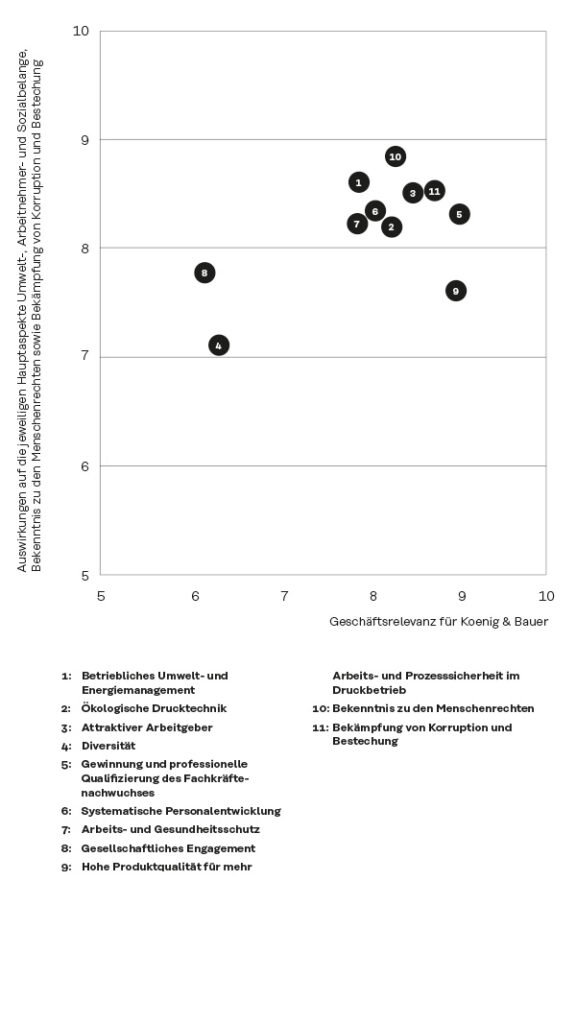
Analogous to previous years, the topics presented in this materiality matrix are also reported on in the 2025 non-financial Group report. The double materiality analysis conducted in summer 2023 in accordance with CSRD requirements and updated in autumn 2025 confirmed the core topics already identified in 2022 (according to the GRI standard). No specific framework was used for the preparation of the 2025 non-financial Group report. We assume that with the national implementation of the CSRD in 2026, reporting from this financial year onwards will be carried out in accordance with the simplified ESRS standards that are expected to apply at that time.
In summary, the following material non-financial issues are reported on in the subsequent sections: Environmental aspects include operational environmental and energy management as well as ecological printing technology. In addition to attractiveness as an employer and diversity, the recruitment and professional qualification of junior specialists and managers, systematic personnel development and occupational health and safety are among the material reporting topics under the aspect of employee concerns. Under social aspects, social commitment and high product quality for greater workplace and process safety in printing operations were assessed as material. This is followed by a presentation of the aspects of commitment to human rights and anti-corruption and bribery precautions.
As part of the risk inventory conducted at the end of 2025, no material, reportable non-financial risks were identified that result from the company’s own business activities, business relationships, products or services and are very likely to have serious negative impacts on the non-financial aspects mentioned. Risks affecting the company externally are presented in the risk report in the combined management report (see pages 40 ff. of the 2025 annual report).
Environmental aspects
In addition to compliance with high quality and safety standards, environmental aspects are taken into account at Koenig & Bauer within the scope of the possibilities. The production plants in Radebeul, Würzburg and Dobruška hold DIN EN ISO 14001:2015 environmental certification. The Industrial production company at the Würzburg and Radebeul sites and the foundry operations in Würzburg also operate an energy management system in accordance with DIN EN ISO 50001:2018. Koenig & Bauer Sheetfed received EMAS certification in the year under review. In terms of environmental aspects, our focus is on operational environmental and energy management and ecological printing technology for customers. We concentrate on reducing carbon emissions and minimising the use of energy and resources as well as noise, dust and odour pollution. This applies equally to our own production and to the printing, finishing and postpress processes at our customers, whom we support regarding the use of environmentally friendly substrates and consumables.
Operational environmental and energy management
Effective environmental and climate protection in the plants as well as the responsible use of resources are central concerns for Koenig & Bauer. This claim is underpinned by the latest process optimisation in the Würzburg paint shop. There, the switch from wet paint coating to a single-coat paint improved the environmental compatibility of the painting process. Volatile organic compounds (VOCs) contained in the hardener and solvent were halved in the course of the paint changeover. The VOC reduction due to lower diisocyanates in the paint, which are below the statutory threshold, also leads to improved occupational health and safety. Furthermore, energy savings result from shorter drying times. In addition, the consumption of VCI and blister films for packaging components can be reduced using transport aids in the paint shop.
Through the purchase and self-generation of electricity from renewable energy sources, we are working on improving our Group carbon footprint. At the sites in Würzburg, Radebeul, Löhne and Veitshöchheim, 100% green electricity is sourced from Scandinavian hydroelectric power. Self-generation of electricity using photovoltaic systems takes place at the Würzburg, Mödling and Radebeul plants as well as at the sales and service subsidiary in Italy. In the period under review, 838,914 kWh of electricity (previous year: 875,187 kWh) were generated with the company’s own photovoltaic systems. Furthermore, solar thermal systems are used for water heating at the Würzburg site. At the Mödling plant, heat is supplied via district heating from carbon-neutral biomass power plants through a connection to the district heating network of Energieversorgung Niederösterreich.
In addition to the use and self-generation of green energy, energy saving and energy efficiency in our plants are another important pillar of our environmental activities. To create the necessary transparency as a basis for deriving energy-saving measures, the VisuEnergy X energy management system developed by Koenig & Bauer for customers was implemented at the Industrial production company in Würzburg, enabling efficient consumption data recording. In addition to modernising the heating line and insulating the heating channels at the Radebeul plant, the compressed air systems are regularly checked for leaks due to their high power consumption in order to save energy through prompt repairs. Compressed air is required at almost all workplaces and machines in production and assembly. Another building block for saving electricity while simultaneously improving working conditions is the transition to highly efficient LED lighting technology at the sites. The corresponding investments and expenses are included in the taxonomy-eligible capital expenditure and operating expenses in category c (see the chapter with the disclosures on the EU taxonomy).
With regard to the climate target issued in 2021, the Executive Board of Koenig & Bauer AG resolved to adjust the target at its meeting on 17 December 2025 in light of changed sentiment on environmental issues, climate target adjustments in the industry environment and limited resources. The previous climate target included a 75% reduction in carbon emissions (Scope 1 and 2) by 2025 compared to the reference year 2019 in our production plants and carbon neutrality from 2030. By 2040, the new climate target is to achieve carbon neutrality for Group-wide Scope 1 and Scope 2 carbon emissions and to reduce Group-wide Scope 3 carbon emissions in relation to Group turnover by 25% compared to the base year 2024.
Sustainable waste management is part of our responsible use of resources. We want to avoid waste as far as possible and dispose of or recycle unavoidable waste properly in accordance with statutory requirements. A distinction is made between hazardous and non-hazardous waste as well as between recovery and disposal of waste. The remeltable metal waste generated in metal-cutting production in Würzburg is an important raw material for the foundry operations. In this context, complete recycling of the wet casting chips from large-part machining in Würzburg is also possible by melting them down in the foundry furnaces. Our waste statistics provide detailed information on the type and quantity of waste generated.
In addition to the corresponding waste quantities in t, the following table provides a Group overview of the consumption of electricity, natural gas, LNG, district heating and other energy sources in kWh in 2025 compared to the previous year. In the year under review, water withdrawal at the Radebeul and Würzburg plants was 34,011 m3 (previous year: 40,831 m3).
Energy consumptions (in kWh) | 2024 | 2025 |
| Electricity | 43,437,194.7 | 43,958,960.9 |
| Gas | 18,805,592.9 | 20,790,325.1 |
| District heating | 16,000,435.0 | 16,205,090.8 |
| Other energy sources | 2,735,662.0 | 170,332.0 |
| Amount of waste (in t) | ||
| Waste | 11,054.0 | 11,322.0 |
Based on these consumption figures, Group Scope 1 carbon-equivalent emissions in 2025 were 6,642.8 t (previous year: 6,712.0 t). Location-based Scope 2 carbon-equivalent emissions in the Group amounted to 15,866.0 t compared to 16,344.7 t in the previous year. For the respective countries, the location-based Scope 2 carbon-equivalent calculations are based on the emission factors of the International Energy Agency (IEA). Market-based Scope 2 carbon-equivalent emissions amounted to 5,953.2 t compared to 6,909.3 t in the previous year.
The calculation of Group-wide Scope 3 carbon-equivalent emissions for the 2025 financial year was again carried out with external support. The IEA emission factors used for electricity and gas include the entire life cycle, including the upstream value chain and grid losses. For the year under review, Scope 3 carbon-equivalent emissions amounted to 2,807,420 t (previous year: 2,515,850 t). As in previous years, Scope 3 carbon-equivalent emissions account for the largest part of Koenig & Bauer’s carbon footprint (2025: 99.6%). The main Scope 3 carbon-equivalent emission driver at 93.5% is the downstream side with product use (category 3.11).
The following table provides an overview of Scope 1, 2 and Scope 3 carbon-equivalent emissions in the Group in t and the carbon-equivalent intensity in t per €1m of revenue.
| 2024 | 2025 | |
| Carbon-equivalent emissions (in t) | ||
| Scope 1 | 6,712.0 | 6,642.8 |
| Scope 2 – location-based | 16,344.7 | 15,866.0 |
| Scope 2 – market-based | 6,909.3 | 5,953.2 |
| Scope 3 | 2,515,850.0 | 2,807,420.0 |
| Carbon-equivalent intensity (in t per €1m of evenue) | ||
| Scope 1 | 5.3 | 5.1 |
| Scope 2 – location-based | 12.8 | 12.2 |
| Scope 2 – market-based | 5.4 | 4.6 |
| Scope 3 | 1,974.1 | 2,155.6 |
Ecological printing technology
Our emission-reduced and resource-saving products and corresponding equipment options support environmental and climate protection. We are thus strengthening our position, particularly in environmentally sensitive markets. Our holistic consideration of environmental impacts also includes the recyclability of our machines. As main components such as steel and grey cast iron are completely recyclable, we make an active contribution to the circular economy.
To reduce carbon emissions during the use of our products, we rely on energy-saving technologies. In the following, we present some of the eco-components and technical solutions developed in recent years to reduce energy consumption, waste and other resources such as inks and coatings.
In sheetfed offset, Koenig & Bauer offers various energy-saving alternatives for the drying process, which is one of the most energy-intensive areas in printshops. The VariDryBlue drying system developed by us in the Paper & Packaging segment is an energy-efficient solution. To dry water-based dispersion coatings, the hot air is passed over the sheets twice, saving the heating of additional room air. With the double nozzle design of the VariDryBlue+ infrared/hot air dryer, energy requirements can be reduced by up to 35%. The VariDry LED-UV dryer consumes up to 30% less energy compared to conventional UV dryers. With various quality measurement and control systems, inspection systems, preset functions and other equipment options, waste can be saved, make-ready times shortened and resource efficiency in printing operations increased for customers.
In metal decorating, the HighEcon dryer contributes to gas cost savings of up to 70% compared to older versions thanks to the energy-efficient KXB burner. In the EcoTNV dryer, the solvent-laden air is fed to the thermal afterburner (TNV) during drying. In general, in integrated systems such as the HighEcon dryers, heat for the dryer is generated in addition to exhaust air purification. The solvents in the exhaust air are used to save energy. Thus, if there is a sufficient solvent concentration in the exhaust air, gas consumption can be reduced. If gas is also replaced by green hydrogen, the carbon emissions of the entire production process can be further reduced. Koenig & Bauer MetalPrint is pursuing this innovative solution and has initiated the “Hydrogen-heated dryer” development project.
In banknote printing, we have developed various systems and components for higher energy and resource efficiency. To save and reuse energy, a synergy between thermoregulation and the provision of a preheated wiping solution was created with a PowerSave unit. For curing inks during or at the end of the banknote printing process, Koenig & Bauer offers energy-saving UV-LED lamps. For higher resource efficiency, an innovative solution optimises ink consumption by adjusting the paper to the length and position of the printing plate. The stencil size, which directly influences ink consumption, can be reduced without impairing print quality. A further feature also makes it possible to apply ink only where it is needed in the printing process. This also contributes to the optimisation of ink consumption.
For a further improvement of energy and resource efficiency in printshops, Koenig & Bauer offers customers the VisuEnergy X energy management system, which enables holistic digitalisation of the company with the recording of environmental data and supports an energy management system in accordance with DIN EN ISO 50001:2018.
Employee aspects
Given our technologically sophisticated, customer-specific machine solutions and services, the know-how and commitment of our qualified workforce are essential pillars for the sustainable success of Koenig & Bauer. Demographic developments increase the need to safeguard the specialist knowledge built up over decades as experts retire across all job profiles and to transfer it systematically to the next generation of specialists and managers. In addition to strategic knowledge transformation, professional and personal further education and training of employees are among the activities in the human resources area. With the Koenig & Bauer Academy and the Koenig & Bauer Online Campus learning management system, our employees have the opportunity to benefit from an extensive range of education and to learn independently, according to their needs and with flexible timing. The range of activities also includes healthcare as well as operational health management.
Respectful and responsible interaction with one another and protection against discrimination are part of our corporate culture. At some companies at the Würzburg and Radebeul sites, the quota for employees with special needs stipulated in the Social Code is exceeded. For example, at the foundry company in Würzburg, the rate was 7.0% at the end of 2025 (2024: 7.1%).
Attractive employer
Adapted to the respective local conditions, Koenig & Bauer offers modern framework conditions, including mobile working, flexitime models and working time accounts. Mobile working allows them to perform their work outside the company using mobile devices. In principle, tasks, areas of activity and projects determine whether and to what extent mobile work is feasible for employees. The proportion of weekly working time that can be spent on mobile work is set at up to 40% at the Würzburg and Radebeul sites, although a certain amount of flexibility can be shown by supervisors. For employees with children in particular, the possibility of mobile working offers advantages for the reconciliation of family and work. In order to steadily increase our attractiveness as an employer, we offer further additional benefits depending on the location. We support mobility through subsidies for bicycle leasing and public transport tickets and offer scope for flexibility in working time arrangements. Our employees also benefit from collective bargaining agreements at many Group companies and Group-wide internal personnel development.
In reconciling work and family, employees are supported with various locally varying offers such as flexible working hours, temporary or permanent part-time models, mobile working, special leave such as family time and sabbaticals. The proportion of part-time employees in the Group was 5.3% (previous year: 5.0%). Furthermore, Koenig & Bauer offers various location-specific childcare and holiday care options. During the 2025 summer holidays, the sixth holiday programme for the children of employees at the Würzburg site took place over two weeks. This holiday programme has been included as a comprehensive concept with two complete care weeks in the nationwide corporate guide to workplace childcare as a practical example of one of four organisational models. The holiday care concept, which was recognised as exemplary throughout Germany by the Federal Ministry for Family Affairs, has also been implemented at the Radebeul site for three years. Furthermore, Radebeul employees can use a day-care centre run by an external provider adjacent to the company premises. On the school-free Day of Repentance and Prayer, the now traditional Children’s and Youth Day took place at the Würzburg plant. Koenig & Bauer has been a member of the Family and Work Alliance in the Würzburg region since 2006.
The staff turnover rate in the Group was 7.0% in 2025 (previous year: 7.2%). The calculation of the turnover rate includes the total number of Group employees who left voluntarily or due to retirement, death or other operational reasons in the year under review. The average length of service at the large plant sites in Würzburg and Radebeul was 19.3 years in the year under review (previous year: 18.9 years).
Diversity
With regard to the potential of heterogeneous teams, we attach great importance to a diverse workforce – whether in terms of gender, origin, age, worldview or experience. Our global positioning already enables us to achieve a high degree of international diversity today. Based on the age structure, the following picture emerges in the Group: of the total employees of the Koenig & Bauer Group, 19.9% are under 30, 42.4% are between 30 and 50 and 37.7% are over 50 years old (previous year: 19.2% under 30, 41.7% between 30 and 50, 39.1% over 50). As with many other mechanical engineering companies, the proportion of women in the Group is lower than in other industries at 14.9% (previous year: 14.7%). Various activities such as the targeted addressing of women via Girls’ Day aim to increase the proportion of female specialists in our manufacturing company. At the end of 2025, the proportion of women in the first and second management levels below the Executive Board at the holding company Koenig & Bauer AG was 33.3% and 17.9%, respectively (previous year: 33.3% and 16.1%).
Recruitment of and professional training for the next generation of skilled workers
The dual vocational training model has a long tradition at Koenig & Bauer for meeting the need for qualified specialists. In its 157th year of existence, the company’s own state-recognised vocational training school in Würzburg ensures professional training for qualified specialists through the close integration of theory and practice. This applies equally to the other training sites in the Group. Through deployment in various departments, apprentices gain a deep insight into the company’s processes. Additional offers such as exchange trips, seminars or stays abroad promote the personal development of young people in addition to their professional skills.
The number of apprentices in technical and commercial professions, including interns, stood at 469 in the Group as of 31 December 2025 (previous year: 449). The Group-wide training ratio was 8.5% (previous year: 8.0%). Training figures include dual students who complete their practical phases at Group sites alongside university attendance. Koenig & Bauer apprentices regularly occupy top positions in the Chamber of Commerce (IHK) final examinations at various Group locations. They are a good indicator of the recognised high quality of the Group-wide training sites.
Systematic personnel development
2025 marks a significant step for personnel development at Koenig & Bauer towards a technologically savvy and dialogue-oriented corporate culture. While the proven structures, qualification programmes and development offers of the Koenig & Bauer Academy continue to form the foundation, the strategic orientation in the year under review focused on the requirements of digital transformation and intensive exchange with our workforce. The “AI Empower 25” programme and the conduct of our global employee survey were at the centre of this, in order to increase the agility of our organisation on the basis of sound feedback and to actively involve employees in the change.
Under the motto “The Power Is You!”, we launched “AI Empower 25”, an initiative aimed at the forward-looking integration of AI technologies and an internal training approach. Based on a strategic partnership with Google, our teams worldwide received access to powerful AI applications such as the Gemini App, Gemini Advanced for Workspace and NotebookLM Plus. Our approach is deliberately decentralised: we rely on the power of multiplication through globally trained AI Champions who act as experts and first points of contact in their respective specialist areas. In the area of AI training, we were able to record 1,806 participations.
A key lever for successful transformation is communication. With the employee survey conducted in 2025, we have established an instrument that provides us with a nuanced picture of sentiment. With a worldwide participation rate of 45.7%, we received valuable feedback on the topics of engagement, satisfaction and operational challenges. These data serve as an objective basis for initiating targeted improvements and making cultural change at Koenig & Bauer measurable and tangible.
In addition to the new transformation projects, we continue to safeguard the administration and documentation of our qualification measures via the Koenig & Bauer Online Campus. In this context, topics of regulatory control of the company are increasingly coming into focus to ensure Group-wide compliance with internal and external specifications. The platform is available to all employees and serves as a central portal for all internal further training and individual competence building. To ensure these specifications were met, numerous regulatory instructions were administered in the year under review. A focus was placed on compliance training with 10,451 participations as well as instructions in the areas of export control and information security.
In addition to technical training, the Academy’s portfolio also includes comprehensive professional training and offers on social and methodological competence, with a total of 36,812 participations realised across various formats. The use of e-learning increased to 31,455 completions (previous year: 28,320). This digital offering was supplemented by interactive formats such as live online training with 2,838 participations and 1,596 participations in face-to-face training. In the area of software competence, 461 training completions were achieved in Google Workspace and 561 in SAP, in addition to the AI content.
In addition, the Campus of Experts lecture series promotes interdisciplinary knowledge exchange by allowing technical experts from a wide range of areas to pass on their know-how directly to the workforce. In the year under review, 118 employees Group-wide used this internal educational offer. A special emphasis within the framework of healthcare and social responsibility was placed on the training of mental health first-aiders to proactively support mental health in the working world.
The continuous development of specialists and managers remains a main pillar. Our established formats such as the international JUMP programme for junior managers (eight participants) and the leadership series for experienced managers (nine participants) develop and strengthen the quality of the management level. In addition, our onboarding programme ensures that employees are familiarised with our corporate culture and digital work environments at an early stage. Within the framework of talent management, systematic development assessments and calibrations continue to take place in the departments with the goal of filling key positions sustainably from our own ranks and securing Koenig & Bauer’s innovative strength in the long term.
Our coaching and mentoring offers are also used and serve the purpose of designing and accompanying development paths, promoting talent, sharing know-how and enabling people to carry responsibility within the organisation.
Occupational health and safety
In the area of occupational health and safety, the production plants in Würzburg, Radebeul and Dobruška hold certification are certified in accordance with DIN ISO 45001:2018. Various measures aim at further improvements in occupational safety and ergonomics. Regular checks and consultations are held to monitor compliance with health and safety regulations and to make recommendations for optimising work processes. Hazard assessments are updated regularly. Event-related instructions and training are intended to sharpen the awareness of employees regarding any hazards that may occur.
8.5 accidents per 1 million working hours (previous year: 9.7) occurred at Group workplaces in the year under review with a loss of working time for the core workforce of one day or more. Based on comprehensive analyses, diverse prevention measures and training are carried out. In this context, monthly reporting of the accident frequency rate by area and department enables targeted intervention. Accident focal points are addressed and communicated with monthly special campaigns.
The various programmes for workplace health promotion and prevention are controlled and carried out by human resources management and by the Koenig & Bauer health insurance fund (Koenig & Bauer BKK), which is managed as an autonomous public-law entity. As part of company integration management, human resources management at various business units in Germany offers employees who have been on sick leave for more than 30 days in the past year a confidential meeting via a personal letter to discuss possible measures to overcome or prevent incapacity and to maintain performance at the workplace. A health team was established at the Radebeul site under the motto “Promoting health together”. Priorities for action are workplace ergonomics, prevention of musculoskeletal disorders and regeneration management. The health team’s offering also includes hikes.
In addition to the diverse activities and offers with health courses and vaccinations, advice and training are another focus, through which health competences are imparted and employees are guided towards health-conscious and ergonomic working and stress prevention. Support is also available through addiction officers for all questions regarding addictive substances and alcohol consumption. For apprentices, courses were again held with a health promotion programme tailored to them to raise awareness of the topic of noise-induced hearing loss, addiction prevention and the prevention of musculoskeletal disorders. To strengthen the mental health of apprentices and teaching staff, there is also the analogue-digital offering You!Mind from the Koenig & Bauer BKK. A special type of preventive health promotion with individual programmes to maintain or restore performance and well-being are the active weeks in selected spa resorts. Hearing tests, vein screenings with evaluation and advice on-site as well as resilience webinars are among the other offers. Regardless of where they live, employees with mental illnesses receive a qualified initial diagnosis within 14 days via the BKK ProPsych programme. Should the initial diagnosis indicate medical necessity, employees receive psychotherapeutic treatment within a further 14 days. Special behavioural therapy for sustainable weight reduction in cases of obesity is also offered within the framework of this programme. In addition to training three employees as psychological first-aiders, we participated in a pilot project funded by the Federal Ministry of Labour and Social Affairs for the Upper and Lower Franconia region. Mentally stressed employees receive free support up to a twelve-month working time reduction of maximum 50% with full wage compensation. The “BGM-innovativ” programme running at the Würzburg and Radebeul sites aims at coordinated care for at-risk and ill employees with musculoskeletal disorders to avoid illness and its chronification, to shorten the duration of illness and absenteeism and to permanently maintain employability. “BGM-innovativ” was expanded in the year under review to include the “Remedies in the plant” option. Company doctors can prescribe remedies for acute complaints that can be taken up in physiotherapy practices located in the immediate vicinity of the plant premises. This earliest possible start of treatment aims at avoiding incapacity for work. In addition to various sports offers such as functional training, full-body training with CrossFit and High Intensity Interval Training, yoga courses belong to the programme of the Koenig & Bauer BKK, which are conducted in a hybrid manner with presence in the plant and online. Children of employees insured with the Koenig & Bauer BKK receive subsidies for swimming courses. Regular education about the importance of screening for the most common types of cancer such as skin, colon and lung cancer takes place via special projects. In addition to webinars and sticker campaigns, lung and skin screenings are offered. With support for company sports festivals, participation of employees in company runs and other team events, health is promoted and team spirit strengthened.
Social aspects
Beyond our commitment to the environment and the workforce, we actively assume social responsibility. We specifically promote social and cultural projects and contribute to more workplace and process safety for employees in our customers’ printing plants through the high quality of our products.
Social commitment of Koenig & Bauer and its employees
At Koenig & Bauer, social and cultural commitment includes sponsoring and donation activities. The Group sponsoring and donations policy governs its basic approach to these matters and defines a consistent process throughout the Group, including approval rules.
In addition to supporting the Africa Festival in Würzburg as a main sponsor, Koenig & Bauer provides financial resources for social projects. At the subsidiary Koenig & Bauer MetalPrint, there is an annual fundraising campaign with a raffle by employees for a children’s and youth hospice in Stuttgart, with the company doubling the donation amount. Sponsoring activities also include projects to drive forward climate protection and the sustainable use of resources. The industry prize of the Print & Media Awards for the environmentally oriented company of the year, sponsored by Koenig & Bauer, recognises the eco-commitment of printing companies.
Furthermore, Koenig & Bauer employees and managers make a social contribution with their voluntary activities at the Chambers of Industry and Commerce as well as Chambers of Crafts, in emergency services such as the Federal Agency for Technical Relief, fire brigade and rescue services as well as in city and municipal councils.
Activities against racism and discrimination
As a globally active printing press manufacturer, Koenig & Bauer sees itself committed to cosmopolitanism and tolerance. Our core workforce includes individuals who have fled their home countries for political or religious reasons. Some have completed their vocational training at Koenig & Bauer, others have started directly their careers here. At our Radebeul site, we support the association „Wirtschaft für ein weltoffenes Sachsen“ (“Economy for a Cosmopolitan Saxony”) by taking specific measures to assist and promote the integration of newcomers and immigrants in the local economy.
High product quality for greater on-site and process safety in printing operations
Koenig & Bauer attaches great importance to the quality of its products and services. Reflecting this, the quality management system aims at achieving ongoing compliance with the highest quality standards in the production and assembly of the company’s tailor-made, innovative and complex products. Quality management systems at the production plants in Würzburg, Radebeul, Frankenthal and Dobruška as well as at the Sheetfed business units in Radebeul, Banknote Solutions at the three sites in Würzburg, Lausanne and Mödling, Coding in Veitshöchheim, MetalPrint in Stuttgart and Iberica in Barcelona, Spain, are certified according to DIN EN ISO 9001:2015. Product development focuses on workplace and process safety, reliability and user-friendliness.
Commitment to human rights
Integrity and respect for human rights are elementary components of our corporate policy. We live these values in our business activities – whether as an employer, supplier or customer. Our principles are summarised in a Group-wide binding Code of Conduct. A guiding principle is the United Nations Framework for Business and Human Rights (“Protect, Respect and Remedy”).
Koenig & Bauer expects its suppliers to comply with Koenig & Bauer’s corporate principles in addition to all applicable regulations as well as international and industry standards. By integrating human rights principles into our terms and conditions of purchase and ensuring strict compliance with them, business partners are encouraged to acknowledge and respect human rights in the same way. By signing the terms and conditions of purchase, suppliers warrant that they do not use child or forced labour, avoid any form of discrimination, respect employee rights and comply with labour laws. The Code of Conduct for Suppliers, required in addition to the terms and conditions of purchase, details the requirements compared to the necessarily more generic presentation in the contract documents. The Code of Conduct for Suppliers includes compliance with statutory and contractually agreed quality and safety standards as well as environmental requirements, particularly in the use and processing of hazardous substances. Aspects such as fair competition through the prevention of corruption and cartels, occupational health and safety, equal treatment and anti-discrimination are also included. Furthermore, the Supplier Code of Conduct requires participants to be encouraged to submit reports of potential rule violations and to protect whistleblowers from disadvantage.
The Code of Conduct also obliges suppliers to provide information on request regarding compliance with principles in the areas of human rights, child labour, minimum wage, business integrity, safety, health and sustainability and to permit audits for verification. To check compliance with the required principles initially and on an ongoing basis with our suppliers, we have established various processes. A supplier qualification process must be completed for new approval or resumption of the delivery relationship. New suppliers must mandatorily sign the Code of Conduct or enter into another contractual agreement with Koenig & Bauer as part of the setup process. The initial check of potential suppliers during their selection includes at least a self-assessment by the suppliers via a questionnaire, in which they must also provide information on compliance with human rights and environmental standards in their companies. Based on the results of the self-assessment and an internal risk assessment, further measures are initiated. These can be requests for certificates, evidence to avoid human rights or environmental risks or auditing actions such as an on-site audit.
As part of the ongoing review of suppliers, we conduct abstract risk analyses according to a defined process. Sourcing primarily from the DACH region reduces risks. The risk assessment model for analysing and addressing corresponding risks is documented in a central instruction. Following an analysis of results and approval of the risk assessment, the suppliers to be checked from critical countries and an action plan are defined. Information from employees and third parties regarding potential violations, dangers or grievances, in particular non-Code-of-Conduct or non-law-compliant behaviour of business partners with regard to human rights and environmental protection specifications, which can also be communicated anonymously via the installed whistleblower system, also flows into the risk analysis. In principle, the action plan for risk minimisation can include a qualified self-assessment with internationally recognised evidence or certificates, an on-site audit or an unscheduled audit in the event of a suspected report, depending on the risks identified. In 2025, a detailed on-site audit was carried out at four suppliers in Turkey classified as high-risk within the framework of the risk analysis. The audits confirmed the consistent conformity of all checked contractual partners with the requirements of our Code of Conduct for Suppliers. In the central areas of human rights, working conditions, environmental protection and business integrity, no violations or defects could be identified. Overall, the level of internal processes and controls for compliance with our Code of Conduct at the checked suppliers was classified as satisfactory. In addition, quality management conducts several on-site audits annually from the circle of existing suppliers.
Anti-corruption and anti-bribery
Corruption and insufficient measures to combat it deprive the affected economies of billions annually and have significant and far-reaching consequences for states, citizens and the economic and social development of civil societies. International studies have proven that the impact of continuous corruption not only leads to lower prosperity, but also has significant negative effects on the level of respect for human rights and environmental protection. Corrupt societies generally exhibit a lower level with regard to participation and labour rights, access to supply facilities and systems, equality, equal access to education, work and equal pay as well as non-discriminatory lifestyle design. In addition, necessary measures or internationally recognised standards or agreements for the protection of the environment, resources or biodiversity are often bypassed through corruption. The fight against corruption is recognised as a collective task of all stakeholders, in particular politics, international organisations, civil society, but especially all economic participants and thus companies.
Because of the presented impact of corruption on human rights and the environment, the sustainable combatting and avoidance of corruption represents an immanent part of Koenig & Bauer’s corporate strategy. We attach a high priority to responsible, sustainable and long-term value creation. We see integrity and law-abidingness in business transactions as indispensable and pursue a zero-tolerance doctrine in this regard. The Code of Conduct of Koenig & Bauer, which applies to all subsidiaries, explicitly clarifies for this reason that no weighing takes place between commercial company interests and the company’s legality duties, and that orders and the achievement of internal goals are waived before we violate laws and regulations.
Compliance management system – control and monitoring
With the Group-wide established compliance management system (CMS), we have created the framework conditions for business practices to meet these high compliance and integrity standards. Since 2023, all relevant German subsidiaries of Koenig & Bauer have been certified according to ISO 37001 (anti-corruption management). Koenig & Bauer Banknote Solutions SA (Lausanne, Switzerland) was added in 2024 as the first foreign company. The contents and activities of the compliance organisation as well as internal processes and controls are continuously checked and developed further to address relevant organisational changes or a changed legal situation. A compliance plan is adopted with the Executive Board and the Audit Committee of the Supervisory Board at the beginning of the year to monitor the functionality and development of the CMS. The compliance plan also defines measurable goals (KPIs) for the CMS for this purpose. The following KPIs are currently defined:
- Rate of completed compliance training in the Koenig & Bauer Campus
- Rate of compliance induction for new employees within the framework of Welcome Days
- Number of compliance reviews conducted at Koenig & Bauer subsidiaries
- Percentage coverage of acceptance of Koenig & Bauer’s business principles by relevant suppliers
- Rate of signed compliance declarations by relevant employees
Decisions regarding the adjustment or inclusion of further KPIs are made within the framework of annual compliance planning.
The CMS is designed for the prevention of violations of laws and standards as well as internal specifications. A regularly conducted compliance risk analysis forms the basis for the organisation and processes. For special risk fields such as corruption prevention and money laundering, special, more detailed stakeholder and risk analyses are conducted for in-depth study. Part of the risk assessment is, in addition to the monitoring of changes in the law and published compliance risks, the continuous exchange with those responsible for the subject areas, processes and controls defined as material in the Corporate Compliance Group guideline of the Koenig & Bauer Group companies. For this purpose, a compliance team was established, composed of representatives from information technology, human resources, accounting, taxes, data protection as well as local compliance managers. Additionally, since 2021, a standardised report on the compliance situation has been submitted by all subsidiaries as part of the fixed agenda of the respective meetings of the supervisory bodies (e.g. boards, shareholder assemblies, supervisory boards, administrative boards).
Guidelines and processes
Based on the results of the risk analysis, guidelines were created and the necessary processes for ensuring rule-compliant and integrated behaviour in business activities were established. Through the continuous adjustment of internal specifications, changes in the risk situation or requirements identified are addressed. The Group-wide rolled-out Code of Conduct, the regulations on the compliance organisation and the relevant Group guidelines are accessible to all employees in their status in the guidelines portal on the Koenig & Bauer intranet.
Certifications
We attach a particularly high priority to the topic area of combatting corruption and bribery in our CMS. For this reason, Koenig & Bauer AG and all relevant German subsidiaries were certified according to ISO 37001 (anti-corruption management). Relevant companies were defined as those with sales, service and procurement activities, but not companies fulfilling pure production or administrative activities, e.g. holdings or management companies. In addition to accreditation with the Banknote Ethics Initiative (BnEI), Swiss-based Koenig & Bauer Banknote Solutions SA was certified according to ISO 37001 (anti-corruption management).
Training
The defined compliance and integrity standards can only develop their full effect if they are known to and complied with by employees. For this purpose, ten online training courses are currently available Group-wide on the compliance topics identified as important based on the risk analysis and the Code of Conduct. The training is offered in several languages and is mandatory for every new employee. The Koenig & Bauer Campus training management system, based on SAP SuccessFactors, automatedly ensures that training is carried out within the cycles determined according to the risk criteria of the employee’s specific position. Compliance with this specification is monitored through regular reminders and escalation processes. After the initial assignment of online training via the Koenig & Bauer Campus at the end of 2017, a total of over 5,000 Koenig & Bauer employees completed compliance training with a direct link to combatting corruption. The rate of employees at Koenig & Bauer trained in corruption prevention according to the training concept increased to almost 95%. The Koenig & Bauer Campus is now rolled out in all 50 relevant subsidiaries, so that almost all employees in Europe, Asia, North and South America are addressed with compliance training via the Koenig & Bauer Campus. Non-relevant companies were defined as those exhibiting no independent, operational business activity or being composed exclusively of personnel also having parallel employment relationships in included companies, e.g. in holdings or management companies. Additionally, face-to-face training is conducted when special needs arise, within the framework of onboarding events for new employees and during on-site visits of compliance officers to subsidiaries.
Monitoring and whistleblower system
Preventive CMS measures are supplemented by measures for regular checking of effectiveness and for deriving possible potential for improvement. In particular, in addition to tracking the agreed KPIs for the CMS, internal and also external compliance assessments are periodically conducted at Koenig & Bauer AG and the subsidiaries for this purpose. In addition to the companies included in the ISO 37001 scope, this concerned Koenig & Bauer companies in China, Taiwan and Austria.
The internet-based whistleblower system enables anonymous reports of potential compliance violations by both employees and third parties. It also includes case management, thereby ensuring full documentation of measures taken to follow up on reports received. Furthermore, it contains a so-called feedback channel to the whistleblower with the possibility of notification regarding receipt, status and result of the procedure. Additionally, this enables queries regarding further information or evidence even if the whistleblower wishes to remain anonymous. Based on the Group guideline, all reports are followed up consistently and, where necessary, disciplinary or legal steps are initiated. Communication of the reporting channel takes place through training, intranet and notices as well as on the compliance website of Koenig & Bauer. The external reporting office created in Germany at the Federal Cartel Office was included in communication to employees. Several reports received in 2025 from various subsidiaries prove that the platform is known and accepted. Consistent follow-up applies equally to reports from media or authorities regarding potential legal violations of Koenig & Bauer companies. In such cases, cooperation to clarify circumstances is sought. Koenig & Bauer complies with any notification or participation duties.
Collective Actions and commitment to fighting corruption
Koenig & Bauer is also committed to the fight against corruption and the development of compliance beyond its own business activities. Since its foundation in 2013, the Banknote Ethics Initiative (BnEI) has established a strict code for avoiding and combatting corruption and anti-trust violations in the field of banknote printing and trade. The principles developed are not only recognised among BnEI members but are shared by a significant portion of central banks and banknote printers worldwide. As a founding member of the BnEI, Koenig & Bauer Banknote Solutions has subjected itself to strict conduct and transparency rules, compliance with which is checked within the framework of the accreditation to be renewed every three years based on an audit programme developed by the BnEI. The accreditation was last extended in February 2024. According to the cycle, the next accreditation audit is due for 2026.
Further details of the compliance management system are described on the Koenig & Bauer website under Compliance.
Permanent analysis of possible compliance risks is a crucial prerequisite for continuing to meet the standards for rule-compliant and integrated business conduct defined in the Code of Conduct and Group guidelines in the future. Analyses and assessments conducted in 2025 in the individual business units, as well as findings from internal investigations, showed no new compliance risks.
In our opinion, there are no reasons to assume that Koenig & Bauer’s CMS in its current form is not appropriate and effective for the Group’s risk situation.
Disclosures on the EU taxonomy
The EU Taxonomy Regulation is a central instrument of the European Commission’s action plan to direct capital flows specifically into sustainable investments. As a uniform classification system, it defines ecologically sustainable economic activities and thus makes a decisive contribution to the EU goal of climate neutrality by 2050. The focus is on six defined environmental objectives: climate change mitigation, climate change adaptation, sustainable use and protection of water and marine resources, the transition to a circular economy, pollution prevention and control, and the protection and restoration of biodiversity and ecosystems.
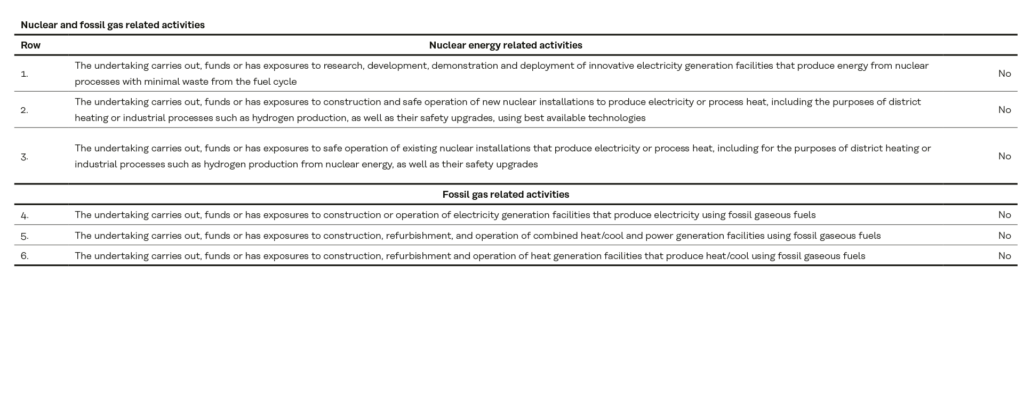
The following information is based on Taxonomy Regulation (EU) 2020/852. We have also taken into account the delegated act on the first two environmental objectives, climate change mitigation and climate change adaptation (Commission Delegated Regulation (EU) 2021/2139 on technical screening criteria according to Articles 10 and 11 of the Taxonomy Regulation, hereinafter: Climate Law), the delegated act on reporting obligations according to Article 8 of the Taxonomy Regulation (Commission Delegated Regulation (EU) 2021/2178) and the so-called minimum safeguards according to Article 18 of the Taxonomy Regulation. Further bases for our comments are the supplements by Commission Delegated Regulations (EU) 2023/2486 and (EU) 2023/2485, among other things with regard to the inclusion of the four non-climate-related environmental objectives in the reporting obligations and new economic activities in the Climate Law. Additionally, Commission Delegated Regulation (EU) 2022/1214 amending Delegated Regulation (EU) 2021/2139 in relation to economic activities in certain energy sectors and Delegated Regulation (EU) 2021/2178 in relation to special disclosure requirements for these economic activities was taken into account in the reporting obligation. Koenig & Bauer carries out no business activities in connection with nuclear energy and fossil gas listed in the annexes of Commission Delegated Regulation (EU) 2022/1214 of 9 March 2022. At the end of the “Disclosures on the EU Taxonomy” section, the first table of the reporting forms mapped in Annex III for the 2025 reporting year is presented.
On 8 January 2026, a new delegated act on Taxonomy Regulation (EU) 2020/852 was published in the EU Official Journal. Entering into force on 28 January 2026, the delegated act comprises Delegated Regulation (EU) 2026/73 with 16 annexes, which amends the delegated act on reporting (Delegated Regulation (EU) 2021/2178), the delegated act on the two climate-related environmental objectives (Delegated Regulation (EU) 2021/2139) and the delegated act on the four non-climate-related environmental objectives (Delegated Regulation (EU) 2023/2486). Against the background of the legal effectiveness of the new delegated act (Delegated Regulation (EU) 2026/73) only after the 2025 financial year-end, we are making use of the existing option according to Art. 4 of this Delegated Regulation and will apply the changes in reporting only from the 2026 financial year.
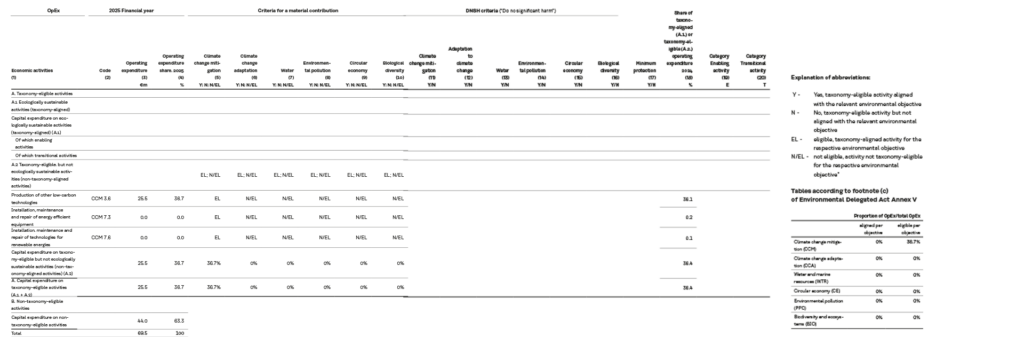
As in previous years, with regard to the first environmental objective, climate change mitigation (CCM), we checked the economic activities of categories CCM 3.6 “Manufacture of other low carbon technologies”, CCM 7.3 “Installation, maintenance and repair of energy efficient equipment” and CCM 7.6 “Installation, maintenance and repair of renewable energy technologies” for their potential taxonomy eligibility and identified material contributions in categories CCM 3.6 and CCM 7.6. Against the background of the implementation of the VisuEnergy X energy management system at the Industrial production company in Würzburg, we additionally checked the economic activities of category CCM 7.5 “Installation, maintenance and repair of instruments and devices for measuring, regulation and controlling energy performance of buildings” for their potential taxonomy eligibility and identified no material contributions to the environmental objective of climate change mitigation. In accordance with the binding interpretation aid of the EU Commission according to notice C/2025/1373 of 5 March 2025, expenses for installation, maintenance and repair services mentioned under CCM 7.3, CCM 7.5 and CCM 7.6 are reported as CapEx or OpEx under these categories. Expenses for the acquisition of the respective products and equipment to which the installation, maintenance and repair services under CCM 7.3, CCM 7.5 and CCM 7.6 refer are assessed under CCM 3.5 “Manufacture of energy efficient equipment for buildings” and CCM 3.1 “Manufacture of renewable energy technologies”. Material contributions to the environmental objective of climate change mitigation were identified in category CCM 3.5.
Both in relation to the second environmental objective of climate change adaptation and with regard to the four non-climate-related environmental objectives (protection of water and marine resources, strengthening of the circular economy, reduction of pollution and protection of biological diversity), no potentially taxonomy-eligible economic activities with a material contribution to these five environmental objectives could be identified within the framework of the analyses conducted. Also with regard to the economic activity “1.2. Manufacture of electrical and electronic equipment” for the EU environmental objective transition to a circular economy, there were no relevant capital expenditures in the reporting year.
Within the framework of disclosure obligations, the proportions of taxonomy-eligible and non-taxonomy-eligible as well as taxonomy-aligned and non-taxonomy-aligned economic activities in the 2025 financial year in total revenue and in capital and operating expenditure in relation to Group activities are disclosed for the environmental objective of climate change mitigation. Revenues, capital and operating expenditures could be clearly assigned to a taxonomy-eligible economic activity through the analysis conducted. To avoid double counting, assignment to a taxonomy-eligible activity took place only if the economic activity was not already taken into account under another activity.
Taxonomy-eligible revenue
The taxonomy-eligible share of Group revenue is defined as the part of net revenue of the 2025 financial year originating from products in connection with taxonomy-eligible economic activities (numerator), divided by consolidated net revenue 2025 (denominator). Our consolidated net revenue of €1,302.4m is presented in the consolidated financial statements on page 63 of the 2025 annual report in the Revenue line. Further details on our accounting principles for our Group revenue can be found on pages 76 f. of our 2025 annual report.
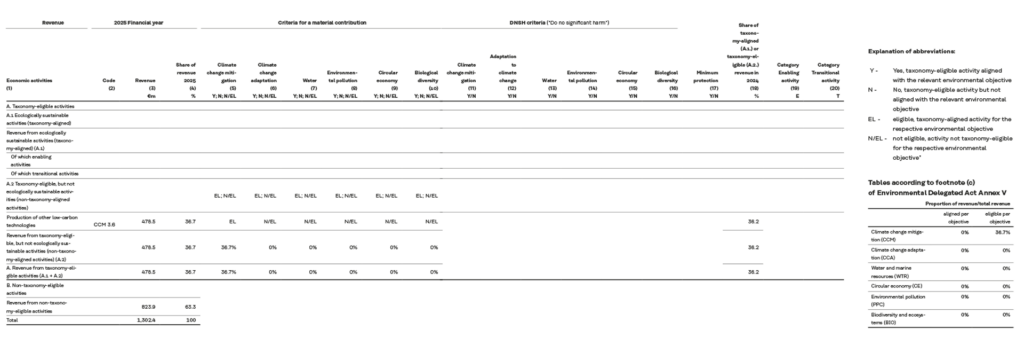
Based on the classification of our economic activities according to NACE codes 28.29 and 28.99, we oriented ourselves towards the requirements of category CCM 3.6. “Manufacture of other low carbon technologies” in deriving taxonomy-eligible revenues. With regard to the environmental objective of climate change mitigation, we classified revenues with products or product groups as taxonomy-eligible if the machines and systems aim at a significant reduction of carbon emissions at our customers in the printing and finishing industry due to the technology in use and these do not already fall under sections 3.1. to 3.5 of Annex I of the Climate Law. Under environmental aspects in the “Ecological printing technology” chapter, we present the developed technologies or machines for reducing carbon emissions in print production in detail. These include VariDryBlue drying for sheetfed offset presses, the HighEcon dryer for metal decorating presses as well as the PowerSave unit, LED technology for curing inks in the press and the targeted adjustment of stencil size for banknote printing presses. The revenues determined on a product or product-group-specific basis in the Group’s accounting departments or the respective business units were then cumulated for all products or product groups classified as taxonomy-eligible. Revenue of €478.5m (previous year: €460.8m) was achieved in 2025 with machine technology for banknote printing, sheetfed offset presses equipped with VariDryBlue drying technology, and metal decorators and components delivered with TNV technology.
Taxonomy-aligned revenue
For the identification of possible taxonomy-aligned revenues, we analysed the technologies classified as taxonomy-eligible or the corresponding products and product groups to determine whether they contribute to a material saving of greenhouse gas emissions during product use over the entire life cycle of the machine compared to the highest-performance reference technology available on the market. In doing so, we consistently oriented ourselves towards the corresponding EU regulations for category CCM 3.6. “Manufacture of other low carbon technologies” with a focus on the saving of greenhouse gas emissions in user industries and applied internationally recognised standards for calculation. Life-cycle greenhouse gas emissions for the highest-performance alternative technology available on the market in each case could not be calculated because we could not provide valid evidence or publicly available energy consumption values for competitor machines. Consequently, no taxonomy-aligned revenues in category CCM 3.6. “Manufacture of other low carbon technologies” could be disclosed in the reporting period.
Figure: Share of revenue from goods or services associated with taxonomy-aligned economic activities – disclosure for the year 2025
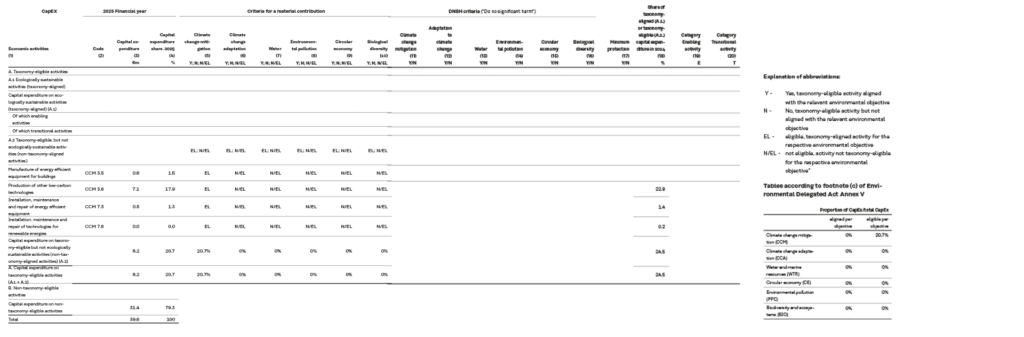
Taxonomy-eligible capital expenditure
To derive the taxonomy-eligible share of capital expenditure, the investments determined by Group accounting according to IFRS are set as the value in the denominator. This investment amount is reconcilable from the additions column in the Group statement of changes in assets on page 80 of the 2025 annual report. Included therein are additions to property, plant and equipment and intangible assets during the financial year before depreciation and remeasurements, including those resulting from remeasurements and impairments for the 2025 financial year and without changes in fair value. In addition to additions to fixed assets (IAS 16) and intangible assets (IAS 38), additions to right-of-use assets (IFRS 16) are also included, as are additions to property, plant and equipment and intangible assets resulting from business combinations.
The first partial value of the numerator for deriving the taxonomy-eligible share of capital expenditure includes investments in economic activities CCM 7.3 “Installation, maintenance and repair of energy efficient equipment” and CCM 3.5 “Manufacture of energy efficient equipment for buildings”. Investments falling under categories CCM 7.3 and CCM 3.5 are classified as taxonomy-eligible capital expenditure according to section 1.1.2.2. (c) of Annex I of Commission Delegated Regulation (EU) 2021/2178 on disclosure obligations according to Article 8 of the Taxonomy Regulation, including the amendment by Commission Delegated Regulation (EU) 2023/2486. To determine taxonomy-eligible capital expenditure of category (a), the capital expenditures of business units with CCM 3.6 economic activities weighted by the taxonomy-eligible revenue share are summed up. Additionally, the proportionate capital expenditures of the Industrial production company are added according to the revenue share of business units with CCM 3.6 economic activities. Due to methodological refinement in determining taxonomy-eligible capital expenditure of category (a), a corresponding adjustment of previous-year figures was made. The sum of the appropriately determined taxonomy-eligible capital expenditures of categories a and c is set as the value in the numerator for calculating the taxonomy-eligible share of capital expenditure, after no taxonomy-eligible capital expenditures were incurred in category b in this reporting period.
Category b includes capital expenditures that are part of a CapEx plan to expand taxonomy-eligible economic activities or enable taxonomy-eligible economic activities to become taxonomy-aligned. While category a is assigned capital expenditures for assets or processes relating to taxonomy-eligible economic activities, category c includes capital expenditures relating to the acquisition of output from taxonomy-eligible economic activities and individual measures enabling the target activities to become low-carbon or leading to greenhouse gas reductions. The corresponding categorisation applies analogously to the comments on operating expenditure in the subsequent sections.
Taxonomy-aligned capital expenditure
Taxonomy-aligned capital expenditure in categories CCM 7.3 and CCM 3.5 could not be disclosed in the reporting period because no evidence of fulfilment of DNSH criteria and compliance with minimum safeguards was provided by suppliers or business partners for the individual taxonomy-eligible capital expenditures. Since no taxonomy-aligned economic activities exist with regard to category CCM 3.6 “Manufacture of other low carbon technologies”, no revenue-related allocation key could consequently be applied to derive taxonomy-aligned capital expenditure according to category CCM 3.6.
Figure: CapEx share from goods or services associated with taxonomy-aligned economic activities – disclosure for the year 2025
Taxonomy-eligible operating expenditure
Operating expenditure in the sense of the EU taxonomy takes into account non-capitalisable expenses for research and development, building renovation measures, short-term leasing, maintenance and repair, among other things. To derive the taxonomy-eligible share of operating expenditure, the total value to be set in the denominator is first determined. One partial value of the denominator is non-capitalised R&D costs, presented in the Group income statement on page 63 of the 2025 annual report. The second partial value of the denominator is maintenance and repair costs in production, sales and administration as well as expenses for short-term and low-value leases included in the production, sales and administrative costs also disclosed on page 63 of the 2025 annual report in the Group income statement. Expenses incurred for measures for energy reduction or increasing energy efficiency in factory buildings and for maintenance of installed photovoltaic systems were not material in the reporting period. Since operating expenditures for taxonomy-eligible and non-taxonomy-eligible economic activities are incurred at Group sites and a more accurate breakdown is not possible at the system level, a breakdown of this difference according to the percentage share of taxonomy-eligible revenues in the total product portfolio is carried out to determine taxonomy-eligible operating expenditures of category a assigned to economic activity CCM 3.6. The amount from the appropriately determined taxonomy-eligible operating expenditures of category a is set as the figure in the numerator for calculating the taxonomy-eligible share of operating expenditure, after no taxonomy-eligible operating expenditures were incurred in categories b and c in this reporting period.
Taxonomy-aligned operating expenditure
Taxonomy-aligned operating expenditure of categories CCM 7.3, CCM 7.6, CCM 3.5 and CCM 3.1 could not be disclosed in the reporting period as no material taxonomy-eligible operating expenditures were incurred in these categories. Since no taxonomy-aligned economic activities exist with regard to category CCM 3.6 “Manufacture of other low carbon technologies”, no revenue-related allocation key could consequently be applied to derive taxonomy-aligned operating expenditure according to category CCM 3.6.
Figure: OpEx share of goods or services associated with taxonomy-aligned economic activities – disclosure for the year 2025