
Risk report
Group-wide risk management system
All business activity entails risks which may have an adverse effect on the company’s ability to achieve its targets. At the same time, entrepreneurial activity means consciously accepting risks to act on opportunities for enhancing enterprise value. If risks are not detected, allowed for and addressed, they may pose a risk to the company’s successful performance.
The Executive Board has implemented a Group-wide system for identifying and managing risks so that management is able to respond to the current risk situation by taking early and appropriate measures. This system ensures that potential risks to the company’s business performance are reported at an early stage and their extent rendered transparent and that they are in line with the risk-bearing capacity and the risk tolerance defined by the Executive Board. Extreme risks, i.e. risks that may have a very severe effect, but which have a very low probability of occurring, are also addressed. In addition to reporting critical market and corporate developments including details of their possible impact on the company’s results of operations, financial condition and net assets, the risk management system heightens general risk awareness on the part of managers and staff, ensuring that risk assessments are incorporated in the decision-making process and precautions are taken at an early stage to mitigate and avert risks.
The risk management system installed at Koenig & Bauer takes into account “dual materiality”. This means that, in addition to identifying and assessing risks that affect earnings, financial condition and net assets (outside-in perspective), the Group-wide risk management system also systematically detects risks that Koenig & Bauer causes, supports or tolerates and that affect the environment or the general public (inside-out perspective).
One aspect of Koenig & Bauer’s risk management activities involves identifying opportunities. In contrast to risks, however, they are not recorded in the risk management system described below. Instead, operational and strategic opportunities are documented, evaluated and tracked in the cross-group strategy and planning process. A description of the main opportunities can be found on page 49 f. in the opportunities report.
Established risk management process
Koenig & Bauer’s risk management structure is made up of the central risk coordination unit that reports directly to the Executive Board, the risk managers in the companies, segments and business units and the managing directors of the group companies that are included in the scope of risk consolidation. The Executive Board controls the risk management system at the Group level and is monitored by the Supervisory Board. The risk management system covers the production units as well as the main sales and service companies. The risk owners at the operating units perform semi-annual local risk inventories and submit corresponding reports. The management of the operating units in question then reviews the reports for any omissions and evaluates the risks.
A bottom-up approach is applied in which possible risks are reported to the responsible executives combined with a top-down approach comprising a list of assumed basic risks defined by the Group. In addition, the owners of the main strategic projects and value-creation processes are responsible for monitoring project and process risks.
In addition to the semi-annual Group-wide assessment of the risk situation, the Group policy provides for a duty to report ad hoc on any risks that exceed a defined threshold. In addition, Group Controlling, on behalf of the Executive Board, prepares impact analyses based on defined scenarios for current exogenous situations with a potential impact on the order situation, project execution and Group earnings.
The Group’s risk management policy documents the tools, processes, relevant factors, reporting channels and risk categories. The Koenig & Bauer Group’s risk management system is based on the provisions of German company law and the German Accounting Standards as well as the principles and models of the Institute of Internal Auditors (IIA) and the Committee of Sponsoring Organisations of the Treadway Commission (COSO).
Systematic handling of risks creates high transparency for pre-emptive, goal-oriented action
For the purposes of more accurate coordination of risks as well as risk-avoidance and mitigation measures, risk is calculated as a negative deviation from an expected figure. This approach systematically tracks risks that are already included in corporate planning as well as additional latent risks that are not accounted for.
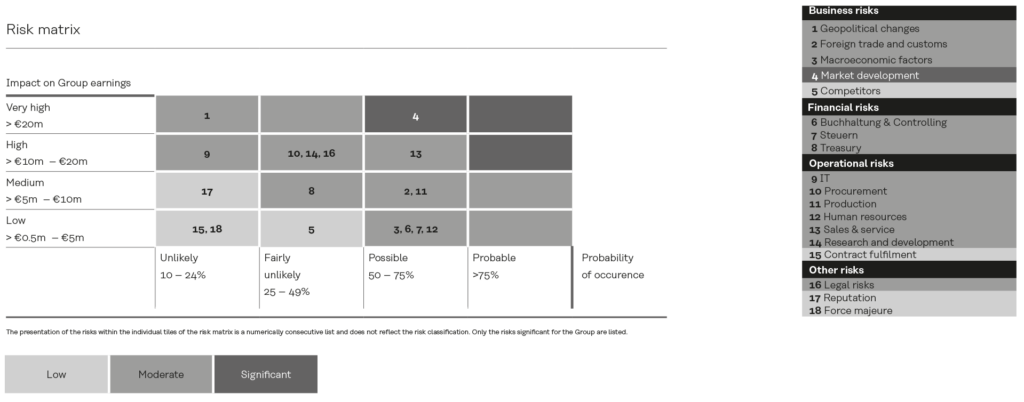
Due allowance is made for the risk mitigation precautions already established, after which net risk is quantified according to probability and potential impact on Group earnings on the basis of clearly described scenarios. The underlying assessment period extends to the end of the year following the reporting year. A standardised approach is applied to achieve a systematic and uniform evaluation of risks. Quantitative or qualitative risks which either individually or collectively with other risks exceed a value of €0.5m and a probability of 10% are reported to the Executive Board. These risks are aggregated in risk groups according to the below matrix and classified as low, moderate or significant on the basis of the combination of two dimensions “Impact on Group earnings” and “Probability”. Particular attention is paid to risks with a high or very high impact on Group earnings or with a possible or high probability. Furthermore, risks that may have a very high impact on the Group’s earnings (extreme risks) but exhibit a comparatively low probability are also analysed in qualitative terms in the risk management process and any necessary measures defined on this basis.
The risk management system is supplemented with monthly Group reports as well as the established and additionally enhanced operational management elements. You can find further information on this in the section on planning, management and control in the chapter entitled “Basis of the Group”.
The risk early detection system pursuant to section 91 (2) of the German Stock Corporation Act installed as part of the risk management system by the Executive Board is reviewed annually by the external auditor in accordance with statutory requirements for adequacy and implementation and discussed regularly by the Supervisory Board’s Audit Committee. Internal auditing oversees the reporting process and checks it for plausibility.
Description of risks
The following section describes the material risks to which the Group is exposed. In the absence of any indication to the contrary, they are equally relevant for all segments. For the purposes of Group reporting, individual risks are aggregated in risk groups, which in turn are divided into the following categories: business risks, financial risks, operational risks and other risks. The order in which the risk groups are described within the categories reflects the risk assessment per risk group calculated on the basis of the individual risks. Risks with a higher risk assessment precede those with a lower risk assessment. The risk assessment is based on the combination of the two dimensions “Impact on Group earnings” and “Probability”.
Business risks
Market development
Despite a generally stabilising situation with regard to market consolidation and customer insolvencies, risks still exist due to uncertainties regarding the regulatory framework and its impact on the final costs of an investment project, which can extend over several months in the field of industrial plant engineering. Such uncertainties could lead to decisions being postponed or made in favour of providers with lower risk. This particularly affects the continued high revenue expectations in the North American market, which could have a noticeable impact on business activities and the profitability of projects in the future. In addition, the persistently weak dollar exchange rate makes projects and price quality more difficult. The customer structure in security printing business, which is dominated by government bodies tied by mostly political decisions, also limits forward visibility, something that gives rise to corresponding capacity and financial risks. Risks arising from regional fluctuations in demand and the security printing business are minimised by the continuous optimisation of the product portfolio and the international sales and service network, particularly in the markets of the future.
In view of the assumptions regarding market development already included in the planning and the measures already taken, significant risks are seen in this regard. This is based on the assumption that the occurrence of the potentially very high risks is possible.
Geopolitical changes
Uncertainties also arise from the heavy debt loads in many economies and the persistent geopolitical tensions. In the event of belligerent or war-like conflicts between nation states, an actual loss of or significant negative impact on sell-side markets, supply chains or transport routes due to additional sanctions and embargoes cannot be ruled out. There are immediate risks for Koenig & Bauer as an importer and exporter of goods and services, as production and delivery could be made more difficult or expensive.
We consider the occurrence of risks in this category to be unlikely, but due to the potentially very high impact, they represent a moderate risk.
Foreign trade and customs
The currently perceptible deterioration in international trade relations and the emergence of protectionist tendencies in some countries in particular may culminate in trade restrictions, e.g. bans, additional restrictions, higher tariffs or other costs. This also particularly affects business activities in the North American market. Koenig & Bauer is addressing these risks by means of specially worded contractual clauses and the use of advantageous delivery terms (including Incoterms) to transfer most of the cost risk, while additionally providing intensive support and advice to customers.
However, customs duties or other tariffs can lead to Koenig & Bauer presses becoming more expensive abroad, which could lead to spending restraint or stronger price negotiations.
Based on the assumptions already included in the planning and the measures already taken, the occurrence of medium risks is possible, meaning that we classify this risk as moderate.
Macroeconomic factors
Koenig & Bauer’s business is exposed to global economic conditions. Economic activity and growth in sell-side markets, changes in the value of the euro against other major currencies and interest rates on borrowings may adversely affect product sales and capacity utilisation, as well as forecasts and budgets. In addition, the uncertainties make it more difficult for our customers to access reliable and attractive financing, as banks and credit institutions sometimes demand risk premiums or further collateral.
This results in moderate risks, as their occurrence is potentially possible but the impact would be low.
Competitors
Industry conditions may affect demand for products and services as well as the business performance of the Koenig & Bauer Group. Changing ordering practices on the part of customers or innovations or repositioning by competitors may impact the performance of individual business segments to varying degrees. Competitors often grant considerable price concessions on sheetfed offset presses and in the security printing segment, which may impede sales of products and the comprehensive acceptance of the price increases that have been imposed due to inflation, rising costs and additional duties. Particularly in Asia, where the market for printing presses is currently growing the strongest, competitors are using local production facilities, which could allow them to offer presses for this market at a discount. Koenig & Bauer relies on pioneering innovations and the highest quality standards, which are implemented at the German and European production sites. Koenig & Bauer’s strategy is to sustainably increase competitiveness and profitability with tailor-made solutions for its customers while simultaneously accelerating the further optimisation of its structures and production costs. Presenting and communicating the technical advantages of its products and services for customers enables reasonable premiums on its prices. At the same time, clear sales targets and ongoing checks support efforts to ensure sustainable pricing for new and used presses. In response to competitors’ behaviour and to increase resilience, Koenig & Bauer is also continuously examining the options for improving its market position and pricing in growth markets through development and production partnerships. However, the behaviour of competitors potentially increases the pressure on target achievement in order intake and project profitability.
Overall, we consider the risks in this category to be low, as the occurrence of a low impact is considered to be fairly unlikely.
Overall, the measures implemented from the completed efficiency programme to enhance operating profitability and long-term competitiveness remain in place to further address business risks. At the same time, the company’s strategic orientation is regularly reviewed, in particular to increase resilience. With its “IMPACT” corporate strategy adopted in December 2025, Koenig & Bauer is responding to global megatrends and resolutely continuing on the path it has already adopted towards greater resilience, digitalisation and modularity.
Financial risks
Taxes
Tax risks can arise from differing interpretations or assessments of circumstances between Koenig & Bauer and the tax authorities. This risk primarily arises in the context of tax audits, adjustments under company law or changes in tax legislation. This risk is addressed through the implemented audit and monitoring processes as well as the earliest possible and comprehensive coordination with the tax authorities.
Due to the complexity and number of potentially relevant facts, a moderate risk remains despite the measures implemented, as its occurrence is possible, but it would have a low impact on earnings.
Treasury
In the Treasury category, risks arise in particular from uncertainties regarding the financing of projects on the customer side, as well as from exchange-rate fluctuations and interest-rate changes.
Financing commitments for our customers’ projects are frequently limited in time or tied to delivery dates. Should there be any postponements in the projects, there is a risk of a deterioration in financing on the part of our customers, for example due to interest rate hikes, the expiry of funding programmes, a reduction in the banks’ risk appetite or due to the customer’s deteriorating balance sheet figures. If financing commitments are withdrawn or if the financing of the projects is no longer viable for the customer, contracts may be adjusted or cancelled, which could impact planned revenue and margins and have a negative effect on liquidity.
Exchange-rate fluctuations and interest-rate changes may expose the company to financial risks. Koenig & Bauer holds financial instruments whose fair value and the resultant cash flows are influenced by market interest rates. In selected cases, derivative financial instruments are used to hedge or eliminate any risks. However, risks remain if, due to regulatory requirements, the use of certain currencies cannot be avoided and hedging is not possible.
In view of the measures taken and the expectations of market developments, which make the occurrence of a medium risk appear fairly unlikely, a moderate risk is assumed.
Accounting & Controlling
Accounting risks can arise from the valuation of projects (impairment). In particular, these can result from a delayed market entry or an adjustment. Risks can also arise if the data underlying the determination of internal transfer prices and make-or-buy decisions do not take into account subsequently changed cost calculations or market prices. Risks in this regard are assessed as moderate, as the potential impact of their possible occurrence would be low.
Operational risks
Sales and service
Group targets and annual budgets are based on assumptions that are subject to uncertainties. For the purposes of sales planning, volumes with corresponding margins are defined as the basis for the companies’ capacity and resource planning. Among other things, budgets include expected increases in prices, pay scales or the cost of materials, on both the production and sales side, as well as the savings achieved as a result of planned improvements. There is a risk that the assumptions underlying the plan do not fully materialise, contrary effects occur or there are delays in the implementation of the necessary measures. In particular, there is a risk that planned prices or price increases cannot be implemented in full or that production costs rise due to changed market requirements or prices. In the security printing sector, there are also risks that government customers will renegotiate existing contracts or postpone planned orders, which could negatively impact revenue and earnings expectations for the planning period. Based on continuous monitoring and analysis of the business environment, the risk is addressed by means of regular budget reviews during the preparation of the forecast and efficient management of the operational business and strategic projects.
The varying and differently assessed risks regarding sales and service are to be classified as at most high and possible, thus representing a moderate risk.
Research and development
Koenig & Bauer regularly invests substantially in the development of improved or entirely new products and processes in order to preserve its competitiveness, satisfy market requirements and gain new customers. This gives rise to risks with respect to technical implementation and feasibility as well as ultimate market acceptance of the new or revised products. In particular, there is a risk that it may not be possible for the expenses incurred to be recouped from sales of the products and services developed on the market, or not within the planned timeframe, thus adversely affecting the return on investment. Risks are addressed in a stage-gate process with appropriate analyses of market requirements before development begins, continuous profitability and risk assessments during development and marketing activities in the course of the product launch. Any necessary impairments are recognised for capitalised development costs that are not considered to be recoverable. Comprehensive project and quality management as well as practical testing with beta users have been established to reduce technical risks.
The potentially high risks resulting from this are currently considered to be fairly unlikely and therefore classified as moderate due to the risk-mitigation measures described above.
Procurement risks
Risks in the supply chain cannot be ruled out in view of the prevailing uncertainties over the availability of materials from suppliers, e.g. critical electronic components such as semiconductors for controlling the printing presses. These can impact Koenig & Bauer in the form of long delivery times, rising purchase prices, losses of revenue, and quality defects. In the absence of alternative options, short-term shortfalls in supplies may lead to production stoppages and delays in our own deliveries with negative effects on capacity utilisation, service revenue and earnings. In addition to close market monitoring and extensive supply chain management, which includes monitoring the quality and reliability of key suppliers, the risks of disruptions to the production process are addressed by means of detailed demand planning and control processes at the Group level. Koenig & Bauer pays particular attention to ensuring backup solutions for single-source suppliers. Strategic and critical components are manufactured in-house or sourced under long-term supplier relationships. Price risks, which could persist in the case of parts with limited availability, are addressed by Group-wide category management with bundled purchasing volumes and by long-term supply contracts. Through close cooperation and regular audits with suppliers, Koenig & Bauer continuously improves the quality of the delivered parts. The quality and backlog rates recorded in supplier management are within the expected range. The risks arising from the deterioration in international trade relations and protectionist tendencies, and the accompanying geopolitical disruptions, have weakened compared to previous years. Following a review of critical supply chains and adjustments to sourcing strategies, dependencies on suppliers and, in the future, on countries will be reduced and the effects of trade restrictions, which can still not be entirely ruled out, will be lessened by diversifying supply chains. Koenig & Bauer also continues to see risks with regard to energy prices, which are addressed by diversifying energy sources and through long-term supply contracts.
In the light of the measures described, the occurrence of procurement risks with their potentially high effects is currently considered to be fairly unlikely. Accordingly, this risk is classified as moderate.
IT risks
Society’s growing dependence on technology and the increasing online networking of information systems increases the risk of intentional or unintentional damage to the Group through the exploitation of vulnerabilities in the IT products and systems used. The consequences of unauthorised internal and external access may include disruptions to the availability of work and production systems and supply chains, data theft, blackmail and sabotage or damage to the Koenig & Bauer Group’s image. In particular, “CEO fraud”, a fraud scenario which criminals use to prompt employees to transfer large sums of money, is increasingly spreading and is being qualitatively improved through the use of AI. A successful risk strategy is established by training employees and heightening awareness of such matters. In recent years, the digitisation process has accelerated significantly and spurred innovations and changes to business models, such as online sales and service, or impacted working methods, in particular the widespread use of AI applications and collaborative tools by the Group’s employees. However, the considerable increase in efficiency is offset by the risk that the costs for software licences and cloud storage could rise unexpectedly and that internal company data could inadvertently be leaked to third parties. In addition, the requirements for Koenig & Bauer from the regulatory environment, e.g. NIS 2, have increased significantly, which heightens the cost risk for timely and full implementation. At the same time, Koenig & Bauer is recording an increased threat from, for example, phishing and comparable attacks. This is reinforcing the need for IT security and a defence response to cyber risks. These risks are addressed through policies and defined IT processes, compliance with common IT security standards, various lines of defence and the implementation of IT security programmes by a Group-wide Chief Information Security Officer (CISO). In addition, there is adequate insurance cover for cyber risks, including a possible interruption to business.
Following the Group-wide roll-out of the SAP ERP system, the Koenig & Bauer Group is exposed to risks with regard to the ongoing operation and smooth phasing-out of legacy systems and the migration of business processes to the new system. To mitigate these IT risks, Koenig & Bauer utilises the services of renowned software consulting companies and has installed an SAP project group. If the legacy systems are not replaced and the ERP software is not installed on time and free of any disruptions, the resultant restrictions to operations or cost overruns for the SAP roll-out project may have considerable financial consequences. In order to reduce these risks, the rollout at the operating companies will be executed successively and on the basis of a uniform platform. In view of the successful rollout of the system at the first few companies, the experience gained from similar complex projects and the high degree of involvement of external experts, the company sees no discernible risks beyond the usual project risks.
The occurrence of the existing IT risks, with a high potential for loss, is considered unlikely and thus generally classified as moderate.
Production risks
Poor quality, rejects and missing parts can result in production and assembly risks. A temporary surge in demand may cause delays in the delivery of individual components. A delivery delay or contractual non-compliance for which Koenig & Bauer is responsible may result in contract penalties or customer credits, thus impairing margins. This also leads to an increase in risk if production is shifted to smaller quantities or to parts that are particularly prone to errors. Koenig & Bauer has a central quality assurance department that defines Group-wide processes and standards, which are then implemented at all plants and relevant corporate divisions by decentralised quality assurance departments. By means of continuous quality controls based on standardised processes, sources of error are systematically analysed and production processes optimised. The internal deadline control takes place via regular coordination and a reporting system. Cost control and management is carried out using periodic cost reports based on a cost accounting system with structured processes for planning, forecasting and variance analysis. In order to optimise the entire supply chain so as to permanently reduce delivery times, Koenig & Bauer is working on operational and strategic adjustments to the internal production network to reduce costs and lead times and to increase productivity. The ability to additionally reduce quality costs for technically complex products on a sustained basis has a major impact on earnings.
The risk of an interruption to our business cannot be completely excluded either. Production delays due to failures or interruptions of individual production facilities or technical infrastructure can have a negative impact on production efficiency and leave noticeable traces on business. Production sites are therefore evaluated together with external consultants and experts from relevant insurance companies with regard to factors liable to cause a business interruption. The insurance taken out on the basis of the evaluations covers fire, severe weather and other risks with appropriate property and selected business interruption insurance. As part of maintenance management, possible vulnerabilities are analysed and preventive measures improved to ensure the availability and operational safety of Koenig & Bauer presses. This limits unplanned outages and plant shutdowns as well as the associated costs.
Taking into account all existing countermeasures, the occurrence of production risks is considered to be possible and the potential impact is considered to be medium, meaning that this risk is classified as moderate.
Human resource risks
Corporate success hinges materially on motivated and highly qualified engineers, specialists and executives. As a result of demographic change, Koenig & Bauer is increasingly confronted with a growing number of highly qualified employees reaching retirement age and leaving the company each year, which requires consistent succession planning, particularly through the creation of redundancies for the orderly handover of topics and business partner contacts. Furthermore, the competition for skilled workers and the declining number of school leavers make it more difficult to retain suitable skilled workers and junior staff. This risk is being actively addressed by expanding vocational training at the state-approved Koenig & Bauer vocational schools. Further essential building blocks for improving employee retention include a wide range of measures for improving employees’ work-life balance, e.g. mobile working, flexitime, flexible working time models such as part-time work and reduced full-time working hours, holiday care or the possibility of sabbaticals as well as other social benefits including company pension schemes, the company’s own health insurance scheme and canteen, various mobility offers, etc. The next generation of specialists and executives are being prepared for their future tasks via trainee and further development programmes, the Koenig & Bauer Academy, which offers more than 1,000 training courses, and also long-term development plans. At the same time, the company is working on improving its external image as an attractive and innovative employer. In addition, through the decentralised production, service and sales companies both inside and outside of Germany, the company has access to specialists whose development potential is regularly assessed.
Instruments such as working time accounts or leased employees are available to address customers’ demand for short delivery times and also to temporarily cushion fluctuations in capacity utilisation at factories. If employees are unwilling to accept flexible working hours or qualified external staff are not available in peak-capacity periods, there is a risk that customer orders cannot be executed within the required period and, hence, that orders may be lost or delays experienced. Similarly, there is a risk of existing capacities generating empty costs in the event of utilisation shortfalls due to missing parts. However, this can be mitigated in the short term by reducing overtime and the number of leased employees used.
In view of the precautions that have been taken and the current capacity utilisation and employment market situation, the occurrence of personnel risks with a potentially low impact is considered to be possible and therefore classified as moderate.
Contract fulfilment risks
In the case of complex mechanical and plant engineering orders, contract fulfilment risks cannot be entirely ruled out. A failure to deliver in accordance with the contract, a delay in delivery or a breach of ancillary obligations for which Koenig & Bauer is responsible may result in a reduction in margins due to contractual penalties or concessions made to the customer. Delays for which the customer is responsible, such as the completion of print shop buildings, may have a negative impact on incoming payments and the recognition of earnings. In addition to professional project management and the continuous optimisation of internal coordination and quality assurance processes, the risk is addressed by drafting the contracts appropriately, so that the risks arising from this are considered to be low and unlikely and therefore classified as low.
Other risks
Reputation risks
In technically demanding capital goods business, there is always the latent risk of barely quantifiable harm to reputation and thus also to the value of the “Koenig & Bauer” brand as a result of quality problems, breaches of industrial property rights or the like. The extent of potential damage depends on the intensity, duration and extent of negative messages. To limit these risks, the Corporate Communications department has established processes to ensure that negative communication on Koenig & Bauer is detected via all channels, e.g. press, social media, forums, in order to specifically address this, e.g. by providing additional information, corrections or moderation. However, given the limited resources, it is not possible to fully monitor all media and to react to all negative news in a timely manner.
A further risk for the value and acceptance of the brand can arise in the event of inconsistent use of representations and language, for example by subsidiaries and sales partners.
A resulting loss of brand value to a medium financial extent is considered unlikely, but represents a low risk.
Disasters and force majeure
Koenig & Bauer is exposed to risks arising from epidemics and pandemics, natural and environmental disasters and social unrest. Due to the highly globalised and interconnected world, local disasters may have a major impact on the Koenig & Bauer Group’s business. Following the end of the Covid-19 pandemic, no significant risks have currently been identified in this connection. Nevertheless, the Koenig & Bauer Group is now aware of this issue. Developments and risks are monitored proactively; immediate reactivation of the measures established during the pandemic is thus ensured. In addition, the scope for mobile working has been maintained even after the pandemic. The sudden emergence of pandemic pathogens cannot be entirely ruled out. Furthermore, direct damage from natural and environmental disasters such as natural hazards is covered by insurance as far as possible and economically reasonable.
Overall, the possibility of a low risk arising from disasters and force majeure is considered to be unlikely. Accordingly, the risk is classified as low.
Legal risks
Koenig & Bauer is subject to a wide range of legal and statutory regulations. The breach of legal requirements, contracts, licensing provisions or intellectual property rights, the negative outcome of legal disputes, official proceedings as well as the failure to observe regulatory requirements may cause financial loss in the form of penalties, compensation payments, sanctions or reputational damage. A special case of legal risk is presented by the proceedings brought by the Brazilian authorities against Koenig & Bauer Banknote Solutions SA, about which the company informed the public in an ad hoc announcement on 24 July 2019. The proceedings are still ongoing. Existing and threatened legal disputes are continuously tracked, analysed, evaluated to determine their legal and financial effects and taken into account in the recognition of provisions in cases in which an obligation is likely. The size of such provisions, e.g. for litigation and official proceedings, is very largely based on estimates. These are continuously reviewed in quarterly litigation reports and on the basis of the lawyer’s confirmations obtained annually and adjusted in good time in the event of any changes.
Overall, the risk of litigation and proceedings having a negative impact is considered high and fairly unlikely, and therefore evaluated as moderate.
The Group is not involved in any legal or regulatory proceedings that are not subject to subsequent mitigation measures in accordance with these principles and thus pose risks to its overall economic situation.
Summary of the risk situation
As in previous years, Koenig & Bauer has already taken due account of the ongoing challenging macroeconomic conditions, volatile interest and exchange rate developments, geopolitical tensions, particularly the Ukraine-Russia war, the conflicts in the Middle East and the simmering China-Taiwan conflict, in its expectations and business plans. Given this persistently volatile environment, the number of risks reported in the Group has increased since the previous year. The total value of the risks as well as the weighted risk value, which results from multiplying the risk value by the probability of occurrence, has decreased compared to the previous period, which is primarily due to the fact that customer investment decisions are being made again following the stabilisation of the applicable customs rates and the conclusion of the major market consolidation.
The Group has sufficient risk-bearing capacity in the light of the current challenges and the associated risks. As things currently stand, we do not see any risks that either individually or cumulatively are liable to jeopardise the Koenig & Bauer Group’s going-concern status. The broad-based product range, which is geared to fundamentally intact sell-side markets, the continued successful implementation of the defined efficiency measures as well as the Koenig & Bauer Group’s strong market position and financial stability limit the risk potential.
Underpinned by ongoing efforts to optimise risk management, risk awareness at Koenig & Bauer is improving steadily. Detailed and comprehensive risk reporting improves the scope for tracking risk-mitigation precautions and for encouraging a responsible approach to opportunities and risks within the company on a sustained basis.
This risk report is necessarily based on available information as well as expectations and estimates believed to be true at the time of reporting and refers to future trends. It is not possible to exclude other or additional risks which may have an influence of the Group but are currently not known or believed to be significant. Moreover, risks may change during the forecast period, resulting in a significant discrepancy in the estimate presented here.